


Latest News
Follow
@sportsinvestor1
Giving us a view from the Emerald Isle we have Joseph Smyth who's excellent posts have been enjoyed by all our team for a good while now
Click here to be taken to Joseph's full blog
Joining the ranks on the 16th of January is Simon Nott, who's 'Tales from the Betting Ring' are are must read for any racing enthusiast
Click here to be taken to Simon's full blog
Simon joins our top blogger Abby Rugg, who is soon to be a big name in the racing World, to reproduce her blog on this part of our website
Click here to be taken to Abby's full blog
June 18 2013
Tales From The Betting Ring – Royal Ascot – Tuesday
I always like to set off for big meetings nice and early and got a
pleasant surprise when I tuned into Radio 2 in the car having missed
the news on
the
TV in my haste to get on the road. I recognised that voice, the dulcet
Westcountry tones of none other than ex-jockey, all-round
good guy and budding comedian Luke Harvey. He wasn’t cracking
jokes though just telling the nation of Chris Evans fans just how much
he likes Royal Ascot. His enthusiasm was palpable and timing impeccable,
well I was impressed anyway, and it seems so was Chris. Look out Cornelius
Lysaght, there could be competition for your racing radio crown!
Talking of luminaries of the press room, there were plenty of familiar
faces in evidence who obviously like to get there even earlier than
me. The vast majority of them, especially the regulars, are gentlemen
(and women) to a man (woman). There are a couple though, that has to
be said are on the missing list apart from all but the top meetings,
appear to have delusions of grandeur. This meeting makes them even
worse, put an already inflated ego in 19th century fancy dress and
their pomposity seems to know no bounds. I’d wager that if I
happened upon Royalty and opened the door for them they would utter
a thank you.
I felt much more comfortable down in the ring with the gentlemen of
the turf as they set up for the day’s business. I was looking
out for my old pal Jack Bevan and Co but couldn’t find them.
That was a bit weird as they bet number three in Tatts. As I stood
gazing, that bloke from Time Team appeared. I wondered if they were
doing a period piece on chimney sweeps as he was dressed in the garb.
Then to re-visit an old joke it wasn’t that bloke from Time Team
at all, but Ian who works for Bevan. He told me that they had decided
to forsake their prestigious pitch in Tatts and bet by the old paddock.
A bit of a gamble on their part but they were up for a punt. Watch
this space.
That bloke from Time Team
The Queen’s procession preceded any real punting action. She
looked resplendent in pink but there didn’t appear to be any
wagering on her choice of hat colour as in previous years. There was
plenty of betting in the opener though. The bookies wanted to get stuck
into Animal Kingdom and the punters were keen to oblige, including
one to the tune of a cool £20,000. The bookies kept the cash
as the favourite flopped behind Declaration Of War. The 15/2 winner
had been 10/1, ‘Terrible result for the Irish bookies’,
said a well-loved PR man for an Irish bookie. I guessed he might be
saying that a bit tongue in cheek, I knew he was when he burst into
a grin.
I got chatting to a real bane of the bookmakers over on the rails.
There is only one thing he likes better than winning off them and that
is goading them after he has won off them. I suggested that the expenses
might be a bit much attending a meeting like Royal Ascot for a week
just to punt. With that he heaved out a house-brick sized wad of readies
and waved it under the noses of the nearest layers and laughed out, ‘This
lot will be paying the expenses!’ Well, you do need confidence.
The ring got the next favourite beaten too so it was their confidence
that was sky-high. Geoff Banks had a brace of beauties on the joint
doing all the hard work while he held court jokingly calling the prices
as loudly as possible. ‘He’ll give the ring a bad name’ commented
one punter with a wink. I’m not sure about that but he may well
have tempted fate, to his chagrin. It did look that Dawn Approach might
have just been beaten in the St Jame’s Palace Stakes, but the
roar that went up when the result was given told the story. Favourite
backers were in business again, including one bet of £33,000
to £24,000 that was landed by a short head.
On the rails, they bet.
War Command won the Coventry Stakes at 20/1 which was another cracking
result for the books. I did spot one punter who likes to bet those
sort of prices. He was sporting an original looking topper but most
importantly was clean-shaven and not be-whiskered. Now he told me
previously that he only shaves when he has backed a winner. His chin
was so clean it could well have been that he nipped up to the gents
and got a celebratory razor out between races. Let’s hope so.
When I was a floorman and asked for what some bookies might have
considered to be a bet out of proportion for the meeting we were
at, a common
bluff retort used to be, ‘Where do you think you are? Royal Ascot?’ Well
it seemed that the vast majority of Tatts had forgotten where they
were, betting to 1/5 the odds in the 19-runner Ascot Stakes. You could
get 1/4 if you looked around but you had to be a pretty canny shopper.
Those lucky enough to be in the Royal Enclosure, at least at the top
rail, had no such problem with most of those firms betting traditional
odds a place.. The favourite was second behind 8/1 Well Sharp.
Extortionist won the last at 16/1. It wasn’t a case of did they
win, but how much, down in the ring. The bookies will tell you that
it is the quietest day and all that but they were smiling all over
the place on the way out. Nasty.
(c) Simon Nott
BLOGGER - Simon
Nott - Click
here to be taken to Simon's full blog
June 13 2013
Tales From The Betting Ring. Newbury 13/06/13
You only have to look at the results from Newbury’s eight-race
card to see that the bookies had it spark bang off today. In fact there
are probably a couple moving their tools from the boot of their two-year-old
Mercedes into a brand spanking new one they bought with readies from
a showroom they happened to pass on the way home. Only two favourites
won, and one of them came second, the rest of the winners included 33/1,
20/1, 16/1 and 14/1. The layers could have hardly written in better results
themselves.
Add to that, in the very first race it seemed that everyone on the
track knew that Toast Of The Town was a certainty. One punter knew
it so much
that he had £4000 on to win £5000. The bookie that took it
even shared it around with his mates in Tatts. He was a bit hasty though,
he could have earned out of his hedging had he waited as weirdly it drifted
despite bundles going on. Then of course it got beaten. Aye aye for the
layers. The next race went to a 14/1 shot, OK Frankie Dettori was on
it but still, another result.
The trouble was the crowd did look a bit on the thin side. There were
a couple of sizeable punters in the ring but they were it. To make
a book you need volume of money on several horses. ‘I don’t
know why I am even here’ bemoaned one Tatts bookie. He was there
on his own too, talk about skeleton staff. ‘I can’t even
take a bet’ his neighbour added. Put this scenario into the mix
and you soon realised that every ‘result’ that went in was
giving the ring the rub down.
There were lighter moments
amongst the doom and gloom that prevailed in some quarters. One punter
had a score on the winner of the 6th at
9/2. It won, at 5/1. You might imagine that the chap might have been
a bit miffed to have cost himself a tenner. Not a bit of it. Much to
the amazement of those around him, not least the bookie who laid the
bet, the erstwhile fellow removed his shirt did a couple of laps of
the bookies, swinging his T-shirt above his head as he went. On is
return he topped off his celebration but getting down and doing press-ups. ‘He
looked a bit knackered by then to be fair’ observed the still
incredulous bookie.
To show just how poor business was one of the biggest rails layers
in the south had legged it by the penultimate. That race went to 14/1
shot Pivotal Silence who just held off the 5/1 jolly by a nose. A delighted
rails bookmaker came running up and breathlessly told me that a well-spoken
lady had enquired about the price of the horse earlier. He had offered
her 16/1, she took that price and then had a whole fist-full of other
tenner bets for other named, but unseen, companions. The bookie took
the hint and had all that and some back at 20/1, well you have top
make a profit. ‘And have had a right touch’, words he managed
to get out just before, ‘Ding Dong – Steward’s enquiry’.
These days you wouldn’t normally worry too much. But on this
occasion, the winner was long odds-against keeping the race. Our bookie
mate that oh so briefly copped the lot looked like a condemned man.
He didn’t have to suffer for too long though. The exchanges were
right and places were reversed without too much time deliberating.
Character building for both the bookie and his lady customer, let’s
not forget her.
‘
They’ve always run out of money by the last if there are eight
races’ piped up Natalie on the rails. She could well be correct,
hardly a bet appeared to be struck before the final kick in the bookies
metaphorical goolies. A 20/1 winner, but a skinner when you haven’t
taken two bob is hardly a result. Oh well it’s the weekend to
come, don’t worry chaps that car dealer will still have the new
Mercedes in the window.
(C) Simon Nott
BLOGGER - Simon
Nott - Click
here to be taken to Simon's full blog
June 4 2013
Tales From The Betting Ring – Epsom, Oaks and Derby
I got talking
to ex-jockey, star of TV and radio and all round good guy Luke Harvey
before racing on Oaks day. I have to say he is one
witty bloke. If only somebody would commission an adults-only post
watershed racing show it would be hilarious viewing. He had a colleague
and I in stitches as he got stuck into various topics lambasting
all and sundry. Quite a genuine comedian, though it was lucky none
of the
course photographers were in earshot. I hear Luke does after-dinner
speaking, I’d bet good money he’d have everyone rolling
about in no time, just one tip though, if you do book him, double-check
he’s absolutely clear on which town the venue is in!
The Racing Post sponsored an ice-cream van, renamed for the event, ‘Mr
Tippy’. It proved very popular with punters on course that had
found the free ice-cream voucher tucked away in the paper. Anthony
Kemp had a go at serving one up for the benefit of the cameras, it
has to be said he wasn’t that great at it. Most onlookers we
horrified that after one lick from Aly Rowell the very tasty and
amply (if somewhat lopsided) filled cone was unceremoniously thrown
into
a nearby dustbin.
There were plenty of bookmakers down on the rails who would have happily
accepted a second-hand ice cream. Nobody was complaining about the
sun but probably for the first time this year the sun-lotion was being
applied. The aroma of Soltan merged with that of burned bookie fingers
after the first when well-backed 3/1f Thistle Bird got the money for
connections and punters. Not just metaphorical burned fingers in the
case of bookmaker Simon James who needed a previously burned hand bandaged
to stop the sun tormenting it further.
Some layers were complaining that business was poor out in Tatts.
Maybe they should invest in ice-cream vans because ‘Mr Tippy’ did
a roaring trade long after those tearing vouchers from The Racing Post
had been and gone. While obviously great advertising for the paper,
the livery was a little too good for at least one novice lady racegoer
who queued patently and then tried having a fiver on one in the Oaks.
There weren’t many books moaning after Talent won the feature
at 20/1 especially as she defied Secret Gesture who was one of the
best-backed in the race.
I’m told things got a bit ugly out in the ring when a brawl broke
out. Depending on who you asked the fighting ranged from a couple of
idiots slugging it out to a damn good dry run for world war three.
Either way it’s something that nobody wants to see at racecourses.
The only winning clear favourite of the day being in the opening race
Oaks day looked to go the way of the bookies. Not so according to some
I got talking to in the hotel later on. It wasn’t the results
they were complaining about but the business. Very poor with high expenses
according to them. It didn’t seem to stop them ‘celebrating’ in
the bar well into the early hours though, not wanting to hear any more
tales about ‘poor bookies’ which were almost bringing
me to tears I left them to it.
Derby Day was heaving in comparison to the Oaks, at least in Tatts,
the empty pitches on the rails were evidence of what business is
like on Members on the day. Most put it down to the dress restrictions.
Bookies didn’t have to wait long for their first ‘result’.
The first race went to 25/1 shot Pasaka Boy. There are some in the
ring that love a gloat when they are winning, as I passed Geoff Banks
betting on the second row he called across asking if I was security
to protect all his money. That was tempting fate if ever I heard
it, karma must have heard it too because Thunder Strike, one of the
3/1
joint favourites, won the next and Geoff had laid a lumpy one.
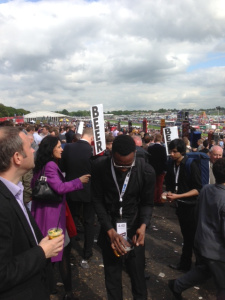
It was so busy in Tatts that getting around was a bit tricky especially
as it was busy with groups of blokes walking around with pints of
beer in flimsy plastic ‘glasses’. Not only that but there
seemed to be scores of chaps with mobile beer kegs on their backs
dispensing
the stuff to what appeared to be a never ending customer base. It
did make me think that it was lucky that there are very few floormen
running
around having back bets these days. Knocking beer flying in the course
of hedging a bet would have been inevitable and probably result in
the poorly paid workmen doing his wages in replacing spilt pints.
It is often lamented that
money doesn’t circulate around the
ring any more contributing to its demise. Well it seems that not all
bookies are too keen to take hedge money. Geoff Banks called out again,
but this time he had the needle. He was giving the Coronation Cup the
swerve, using the time to bet on the Derby instead. It transpired that
the punter that had won the lump on the previous race and wanted to
play some of his winnings up on St Nicholas Abbey. Geoff had no intentions
of betting on the race but was keen to accommodate his customer despite
not pricing the race up. The horse was 4/11 all around him so laid
a bet of £1200-£3300 as requested. Shortly afterwards a
neighbouring layer went 2/5. Our hero hopped off the stool and asked
him for £600-£1500 as a hedge. It is then that Geoff told
me the layer did an extended ‘Betfair twist’ peering into
his computer, then after an ‘inordinate’ length of time
replied he could have a monkey of it on. Disgusted of Sunningdale told
him to forget it and nothing was done. No doubt the boss of the firm
in question was delighted that he had made that decision when the favourite
won easily backed into 3/10, not so much Geoff.
There were some decent bets for the winner of The Dash, Duke Of Firenze
including one of £5000-£800, come racing, get the fractions.
You had to feel for the gent who laid the bet though, if it was his
bogey he must have thought he had it beaten. It looked so cooked that
people on the Internet laid it to the tune of £27 at 999-1, at
least that was the rumour. How do you feel when you lay that sort of
price and it wins? Nasty.
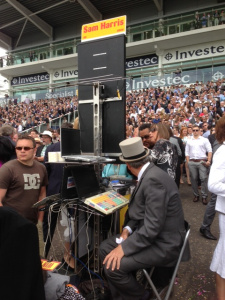
It did seem that much of the ring were more than happy to get stuck
into Dawn Approach in the Derby, there was some business done at 6/4
and 11/8 but never looked like dipping into the realms of odds-on as
some had predicted. The brave souls that went down the book with the
jolly got their reward though winner Ruler Of The World at 7/1 was
hardly a skinner.
The last race of the day was an impossible-looking 16-runner handicap,
mind you, finding the winner would have been easier than finding a
bookie betting 1/4 the odds a place. That winner was 25/1 Arctic Feeling
providing the ring with a result to end the meeting. I have a business
idea for anyone wanting to make a sure-fire financial killing next
year. By the last there would have been a multitude of ladies who I
reckon would have happily paid a pony for a pair of flip-flops after
spending all day being tortured by their footwear. Maybe that is why
the Queen had already legged it by then, though I expect she brings
her own.
(C) Simon Nott
BLOGGER - Simon
Nott - Click
here to be taken to Simon's full blog
April 4 2013
KATIE WALSH CAN RIDE SEABASS TO VICTORY IN GRAND NATIONAL
'WILL a female jockey win the Grand National?' is the question that has been hitting the headlines this week, and I think it could happen.
Katie Walsh, sister of champion jockey Ruby Walsh, is the only woman riding in the race and she will be partnering Seabass again, who finished third last year.
Seabass almost galloped to victory last year, but couldn't quite keep up with Sunnyhillboy and eventual winner, Neptune Collonges.
But I believe Katie has come back stronger this year and will charge past the post in prime position.
My money is on her.
I remember watching the 2012 Grand National. I was at my parents' house and we had a family friend over.
He decided to watch the race with us, and when Katie was shown on our television screen, he said: "She won't win. She's a woman."
No one really knew how to answer him. But I did. I replied that being a woman makes no difference to winning or losing, and I believed Katie would produce a world-class performance, as she always does.
And she did. Third position is great - a fantastic achievement, the best position by any female jockey in the race.
But Katie can finish in a better position this year. She can win and everybody knows it.
At the moment, Seabass is around 10/1 to win, and Katie's brother, Ruby, is currently favourite with On His Own at 7/1.
A jockey needs a lot of luck in the Grand National, but with focus
and determination, I am positive Katie will do the girls - and racing
- proud.
BLOGGER - Abby Rugg - Click
here to be taken to Abby's full blog
April 3rd 2013
Tales From The Betting Ring – Exeter 02/04/13
There was an early scare when a 10am inspection was called after a chilly night up at Haldon. A scare is all it was though as racing eventually went ahead under glorious sunshine. It soon became evident that there were plenty of people extremely happy about that. Now there are always going to be plenty of people happy that racing at Exeter goes ahead because it is traditionally very well supported, even in horizontal rain. Though as already explained, inclement weather was not an issue today. Today was Finlake Holiday Park ‘Family Fun Day’ and the families came out in their droves. There appeared to be kids everywhere, all over the place, swinging on bars in the stands, careering around the enclosures and basically having a whale of a time. It was not only young racegoers of the future learning to love the game enjoying themselves. We could have easily witnessed the champion jockey 2023 learning their trade in either of the two pony races that preceded the mammoth 8-race card. It was great to see a film crew that looked to be from some sort of children’s’ TV show covering the races as well as Grand National winning jockey Daryl Jacob giving words of support to the riders.
Of course, all the youthful racing prodigy had parents and guardians with them. A fair few of them appeared to be novice racegoers but still looked keen to get involved in-between trying to keep tabs on their whirling-Dervish charges. The regular faces were all there too, Badger, Armaloft and the pro-punter with the big binoculars, well outnumbered though, because for all intents and purposes the meeting had a bank holiday feel to it. The ideal opportunity for a racing shop window.
The bookmakers had turned out in force too, some so keen it appeared that they were so early they almost beat the gate-men. The atmosphere was buoyant, probably a combination of a decent-sized crowd in front of them and the much-welcomed appearance of the sun at long last. If things were rosy in the ring before racing the bookmakers were positively beaming after 16/1 Fuzzy Logic, the outsider of five, won the opener. Despite much of the business being small there were still some decent-sized bets to keep the layers on their toes, all of which stayed in the hods.
With the excellent atmosphere, loads of new faces (and potentially long-term clients) in attendance and cash in the satchel the bookmakers were in full public relations mode. The ideal opportunity to get people to feel comfortable betting in the ring. After all for a lot of us the betting ring is second nature, and for some a second home, but it can be daunting for someone new to racing. After all, it would be so much easier and possibly more comfortable for the uninitiated to bet with the Tote or in the betting shop. Yes the bookies were on a charm offensive.
At least you would think that’s how it would work wouldn’t you.
The third race on the card was a 17-runner handicap. Traditional odds would be 1/4 a place which a few layers bet to, most went 1/5 and one 1/6 the odds. OK, we all know that in this particular race the place terms would favour the punters, at least on paper but would it have really hurt to play the game on a day like today? They probably didn’t deserve the 16/1 winner to be honest.
That was bad enough but a small section of the Exeter betting ring really excelled themselves in the 4.10. It was a nine-runner Hunters’ Chase with an odds-on favourite. OK once again not ideal for betting each-way if you are a bookie. The traditional odds should have been 1/5 which some bet to, others bet 1/6 but three that I saw bet to 1/7 the odds a place. Now if that wasn’t bad enough, you just sort of know that the novice punters queuing up to have their couple of quid each-way aren’t looking at the bottom line of the bookmaker’s board to see what terms they are getting. No they are clueless and just betting to the odds they can see in front of them. The final insult to injury is that those books were generally the same odds as their neighbours. The 4/9 favourite finished third behind a 20/1 winner and 66/1 runner-up with the well-backed odds-on jolly in the frame third meaning they only had two places to pay out on anyway.
The rest of the card passed with more ring-friendly results including the 28/1 winner of the last.
When I worked in the ring with bookmakers we had to continuously try and battle against the stereotypical view held by a lot of punters. That was that we were all graspers that would have them over at the drop of a hat. We did our level best over decades to try and convince them that we were in fact sporting gentlemen of the turf. With the majority of layers that is still the case. However, seeing the way some firms do business you do start to wonder.
Sadly, when betting rings are in serious decline, some ‘bookmakers’ are their own worst enemy.
BLOGGER - Simon Nott - Click here to be taken to Simon's full blog
March 27 2013
Snowing again? Grand National selection
Ok so the weather recently may be as unpredictable as the decision making of Sebastian Vettel but it’s something we are going to have to get used to. Get over it. Let it not temper you enthusiasm for the climax of the National Hunt season. Put the flat racing aside for a couple of weeks and try get ahead of the majority in finding value in the Grand National. Everyone bets on the Grand National, so it’s never too early to have a look.
Firstly, if you like On His Own, I’d say it’s probably best that you get on soon. I can’t see the current 8-1 offered being around for long. It is looking likely that Ruby Walsh will ride the nine-year old, especially now with the other Willie Mullins trained runner, Prince De Beauchene coming out of the race due to injury. That seems to have made the decision a bit easier for Ruby and ok so he may have other options, with Colbert Station, Seabass and Join Together but On His Own looks the most likely going on all known form. The Presenting gelding looks capable of going close, having looked to be travelling smoothly and taking well to the fences in last year’s race. For me he was ridden like a horse that day that connections were unsure whether he would stay the trip or not, but he got himself into a good position having travelled strongly early on. He looked to be relishing the test and you can expect a more prominent display this time round. The once a year punters are sure to latch on to the Ruby Walsh factor, so his price may half before the event, and it is not hard seeing him going off a lot shorter on the day.
As much as I like the chances of On His Own, at this stage Chicago
Grey looks one who is overpriced.
There is no doubting that Chicago
Grey is a well campaigned horse but as a 10-year-old now, he looks
capable of running a big race in
this year’s National (eight of the last 10 winners have been
aged either nine or 10). For starters, we can only go on what we have
seen in regards to him and the Aintree fences but he looked to be enjoying
the big fences as he jumped the first four well in last year’s
race, only to be brought down at the fifth.
It has been a varied season
for the 10-year old, winning just once in five starts. Having unseated
in a Grade 1 at Down Royal on his reappearance
this year, he shaped encouragingly in the Henrietta Knight Handicap
Chase at Cheltenham, until a blunder four out cost him any chance.
He followed that with a below par effort, 38 lengths adrift of Bog
Warrior and Zaidpour in a Grade 2 at Gowran Park. His latest effort
proved his well-being for this event however, where he produced a performance
he didn’t look capable of. Chicago Grey has never been a ‘sexy’ horse,
more of a grinder than a flashy performer. However, his Grade 2 Red
Mills Chase win at Navan oozed class, over a trip that was probably
shorter than ideal for him. He was sent off the outsider of four that
day, only to beat a strong field virtually on the bridle.
A winner of
the National Hunt Chase at Cheltenham in 2011, he proved his stamina
for this kind of the test, running out a four and a half
length winner of the four mile event, from the Scottish Grand National
winner Beshabar. A winner on good, good to firm, soft and heavy ground,
conditions will not be a problem for Gordon Elliot’s horse and
the 14-1 offered for the grey looks generous at this stage.
Furthermore,
Gordon Elliot’s charge is beginning to look a seriously
well handicapped horse, getting into the National off a mark of 141.
At the time, that was 2lb lower than his Irish mark, but in light of
his Navan win he is effectively 8lb well-in in the National. He looks
set to carry 10-7 in the race, the lowest weight he has ever carried
throughout his career. Luck in running plays a huge part in the Grand
National and if similar hold up tactics are deployed, of course he
is going to need plenty of luck in running. A clear round however,
could see him go close.
BLOGGER - Joseph
Smyth Click
here to be taken to Joseph's full
blog
March 25 2013
We
have some fantastic news to pass onto you this afternoon
WE HAVE A BRAND NEW SITE SPONSOR
7 Valley Financial

"We are very pleased to have struck up the
three year deal with 7 Valley Financial, and I can say from personal
experience that the 7vf team have saved me personally over £1000
in the past twelve months alone - I would have no hesitation in recommending
them to you. Well worth a look at their website, and their friendly
team are always on hand to save you money whatever your circumstances." Jon
Owen, Partner and founder The Sports Investor
Whether you’re looking to make sure you have the most cost efficient
borrowing, comprehensive personal and family protection, or simply want someone
to make finance and planning simple and easy to muster, 7 Valley financial
can help. 7VF was created with very clear
and simple values. Let us help you understand what you have, where you’re
going, and help you get to where you want to be by giving clear, honest and
straight forward advice. We work to the basis of ‘If it isn’t broken,
don’t fix it!’ and make sure you understand why we have given you
specific advice, because we are more interested in building long-term relationships
with you rather than short term gain.
7 Valley Financial- Advice you
can trust.
What do we do:
· Mortgages
· Life Cover
· Critical Illness
· Income Protection
· Family protection
· Pensions
· Investments
· Business Insurances
· Commercial
· Buildings and contents insurance
· Buy to lets
· Let to Buys
Please support
them and visit their site
www.7vf.co.uk
March 19 2013
Tales From The Betting Ring Cheltenham Gold Cup Day
Gold Cup Day started as a bit of a hangover from the World Hurdle though certainly not from booze, at least in my case, though in that respect I did appear to be in the minority. Dressed for the forecast rain I bumped into two of Geoff Bank’s glamour girls, anyone that read Thursday’s blog will know that I had been somewhat bullish about Reve de Sivola in the World Hurdle. They were both very sympathetic at my near miss, it didn’t last long though. One of them pointed out that I didn’t have a new tweed suit on but was wearing a distinctly non-glamorous raincoat, ‘With pen marks on’ as they noticed, to add to my shame and chagrin. It wasn’t all bad though, Geoff’s ex-clerk gave me a commiseration kiss on the cheek. Just a shame he is called Dave.
I did manage to avoid the tweed I couldn’t afford to buy on a visit to my mate the equestrian artist David Dent. He had a stall down at the tented village which was doubling up as a studio. Catching him putting the finishing touches to a painting was a rare treat. Maybe out of next year’s winnings…
Gold Cup day is often different class when it comes to punters really having a go. It didn’t take long for word of the first actually confirmed genuine big bets to come filtering though. One Irish rails firm of some repute had evidently taken a stand against the jolly Rolling Star in the opener laying a £70,000- £20,000 and a monster £137500 – £50,000 as well as some ‘smaller’ wagers that would make your eyes water on any normal day. They were rewarded for their courage and never really had a moment’s worry as Our Conor ran the field ragged to win in most impressive style.
Business looked good on the rails where there appeared to be a veritable scrummage to get on. The forecast rain had started but not to the extent predicted in some quarters. It was enough for the the betting ring to mushroom umbrellas though. The announcement asking for bookies to take them down during racing didn’t exactly fall on deaf ears, but the mayhem that would have ensued with a couple of hundred computer systems going into rain/electricity meltdown down had they obeyed wouldn’t bear thinking about.
If there wasn’t excitement enough down in the ring as betting on the Gold Cup reached frenzied proportions it got notched up further. It wasn’t news of another monster bet but the appearance of a couple of TV celebs in the shape of Russell Brand and Alan Carr complete with extended entourage. Having never seen either of them in the flesh before I was at first surprised just how tall the former is. Then doubly shocked that his ‘minder’ was even taller and at least twice as wide. There were to be no ‘Benny Hill’ style shenanigans as seen around Channel 4 Racing earlier in the week with that man-mountain about. The first racegoer to try getting up close and personal with his charge soon found his was blocked by a rock-solid arm of tree-trunk proportions.
The comic duo wandered up to the bookies for a bet, though I assume they weren’t the ones who had a couple of £22,000 – £8000 on the Gold Cup winner Bobs Worth. It has to be said that the punters were getting their own back after the outsider carnage and in-clover bookies of previous days. The next favourite won too, though is such cruel circumstances. when 20/1 Oscar Delta, who looked certain to win un-shipped it’s jockey on the run-in. The horse appeared to try to go around the course again then jinked at the last minute when hitting the near invisible rope blocking its way. That mishap left the well-backed favourite Salsify to win the race. 50/1 shot Divine Intervention finished 2nd and appeared aptly named. You’d hope that the multitude of punters clamouring to draw their winnings would have dropped a couple of quid into Comic Relief to acknowledge being jammy so and so’s.
The ring appeared to be half as busy as it was during the Gold Cup for the last couple of races, which was probably just as well for the layers when a right old touch was landed in the last care of the Mullins and McCoy combo with Alderwood. A lot of that business appeared to have been done off course so the ring only took the hit at around the 7/2 mark. It did look as if the majority of layers were not at all keen to stick their necks out and had already snapped the elastic bands around their winnings from earlier in the week so damage to their profits were probably limited but it was certainly last blood to the punters in what had been a bookie’s week.
So that was the end of another amazing Cheltenham Festival, I won’t say roll on next year because business resumes for me at Exeter on Tuesday. Proper job.
BLOGGER - Simon Nott - Click here to be taken to Simon's full blog
March 19 2013
Tales From The Betting Ring Cheltenham Thursday
Well there it was, Cheltenham day 3 and all our hopes riding on Reve de Sivola. As is the norm for me when an exciting day beckons, I was up and at the track very early ready to soak in all the atmosphere. It was a glorious morning too, blue skies and sunshine, everything augured well for the day.
Being on-course so early there was plenty of time for catching up. One of the first bookies I saw was Johnny Boy, he used to work for Westcountry bookmaking legend and D-Day veteran Jack Lynn back when I did. He ambled up to me and said that his daughter Grace had been reading (and hopefully enjoying) these blogs. I told him how pleased I was about that. He then went on to say that Grace had made a request that I give her a mention in this one. Once he told me the reason and reminded me of the story I could hardly refuse. Some years ago Johnny and I were both working down at Lower Tatts with Jack. Johnny was one of best clerks around so was on pencil while I was eyes and ears on the floor. He was always very conscientious but had his mind on other things this particular year, his wife was due to give birth to their first child any day. Roy, Jack’s son, was aware of this, but told Johnny not to worry as ‘Nobody would have a baby Cheltenham week’. Sadly his wife Caron was unaware of this unwritten rule and promptly delivered a healthy bouncing girl, yes you guessed it, Grace, on the first day of the meeting. We were of course all very happy for the couple.
The next day Roy and Jack were not so happy. They told me that Johnny had decided that the joys of fatherhood and supporting his wife were more important that racing. Yes I know! But that it how it was, so in their words ‘He had left us in the lurch’. Followed by ‘You’ll have to clerk’. Now I did know how to clerk yes, I had a go once at a Bath evening meeting where the going was firm and each race had half a dozen runners at the most, but that was it. This was a day of monster handicaps. There was nothing for it though, I was thrown straight in at virtually the deepest end ever. ‘Just get make sure you get all the bets down’ was all I was told as both men machine-gunned wagers to me. It was all I could do to do just that. I managed OK for the first couple of races but it got busier and busier. As they were off for the 3rd I was asked how the book looked, I just looked up exasperated and said, with a few expletives, I had no idea how the bloody book looked, and I didn’t.
‘ He’s useless Roy’ Jack decided. I agreed, luckily they got a replacement and I was put back on the floor. On the floor and put to shame that I couldn’t keep up. It wasn’t all bad though, the replacement turned out to be excellent so all was forgotten when it got to getting paid. Anyway, the reason for that story, I can hardly believe it but it was 20 years ago today. Happy birthday Grace, I’ve forgiven you but I’m not sure Jack and Roy have yet, give it time.
Today I wasn’t in the ring during racing so have no real tales to tell, apart from my personal one of woe. It may have been a mistake to go to Geoff Banks’ joint before racing and show his delightful bevy of beautiful lady staff the brochure that contained a photo of the suit I was going to buy with my Reve de Sivola winnings. It was an Armaloft type mistake, though confidence was running high so let it get the better of me. I even promised to buy them all a bottle of champagne out of the winnings too.
Silly boy, I should have learned by now.
I should really have feared
the worst when not long before the off a work-mate of mine called.
Now this fella is a very nice chap with
a heart of gold, but he is the biggest jinx known to betting man if
you tell him you have had a bet. Of course, as any reader knows, I
have told everyone about this bet on Reve at 33/1 and 12/1. He was
just ringing to confirm it was Nick Williams, the Genius of George
Nympton’s charge, that I had backed. I rolled my eyes and replied
an affirmative that it was. I wasn’t quite ready for his reply,
he thought so and just wanted to let me know that he had heard it wouldn’t
win because it had missed some work. I thanked him for his kind words
of good luck and encouragement. I knew each and every one of those
words were cobblers but it costs nothing to be polite.
The worry was
he was watching the race and knew which one I was on. Cue ‘Jaws’ music.
Anyway, the form book will forever tell
us that Reve de Silvola did connections and trainer proud by running
an extremely brave race staying
on resolutely even when headed. He was still staying on when just chinned
for 3rd and the place part of the 33/1 wager in the shadow of the post.
Sorry Gambling Gods but that was a bit cruel. Disappointing but exhilarating
none the less, the horse came back sound and lives to fight in the
top flight another day. Sadly for the Timothy Foxx stall down at the
village that was selling the light blue tweed jacket and waistcoat
ensemble they have missed out on the sale.
Unless of course Geoff Bank’s girls gave him the brochure I
left them. Maybe he went and bought that smart tweed combo himself
with the untold bundles he and his fellow bookies must have won today.
They could hardly have written in better results themselves. The ante-post
money I now have to pull up will be a minuscule drop in his winnings
ocean, but would still pay for the waistcoat. And no, I didn’t
lay the place part as advised yesterday.
I’ll be over the heartbreak
by tomorrow, after all, it is Gold Cup Day.
March 19 2013
Tales From The Betting Ring Cheltenham Wednesday
I got the feeling that there had been mainly carnage in the ring yesterday, but maybe I’d feared the worst slightly too hastily. The first few layers that I spoke to bright and early on Wednesday morning were quite upbeat. The shrewd firm from the Westcountry had stood by their form convictions and not taken liberties with the ‘good things’ their figures highlighted. The workmen that had spent the night in the car stranded on their way back from Plumpton had both slept well. It’s funny how a sleepless night and choosing the costliest evening meal on the menu at the bosses expense will aid restful sleep winked one.
The veteran layer who had decided to postpone selling his pitch until after the festival admitted losing but also that he’d not lost nearly as much as he was entitled to so was perfectly happy with his decision so far. You do get the impression that he is going to enjoy every minute of it even if he does his cobblers each and every day though.
There was one person on course that had been a highly sought-after workman on Tuesday but wasn’t working today. Armaloft Alex. I asked if he’d had a good day on the rails. He looked a little sheepish as he shuffled from leg to leg before admitting that there had been a nerve-jangling incident. It transpired that his boss for the day had asked him to hedge a monkey on the exchanges on the second favourite. That request is a simple task for a regular clerk but our premature-celebration plagued hero was at his own admission ‘slightly ring-rusty’. Not ring-rusty enough to realise that something had gone horribly wrong when the horse he just backed went green for five figures. He’d mistakenly had five grand on instead of the more modest requested stake.
Luckily it all turned out OK when the beast in question was backed (self-perpetuated when exchange users spotted a plunge and followed it in maybe?) But for whatever reason the mistake was rectified with a profitable trade back, so all was well. All except Armaloft was back to paying to get in with no wages today. That was only because the regular team were back and not because of the rick he hastened to add. Hmmmm.
I managed stop a long-striding pro-punter in his tracks for a chin-wag
prior to the first. He was OK with it though as he always has time
for a chat, at least before racing. I told him all about the ante-post
33/1 and 12/1 wagers on Reve de Sivola for tomorrow’s World Hurdle.
Sadly he thinks that there will be several to beat it, though he couldn’t
pinpoint exactly which ones. His advice was to hedge the place part
of the bet, obviously sensible but oh so negative. I hate to ignore
the wisdom of a seasoned professional but it goes against the grain,
but will sleep on it.
Once betting got going in earnest it didn’t take long for rumours
of a £90,000 – £40,000 on Back In Focus to come filtering
through. Not once but twice with a £18,000 – £8000
to top it up. It looked for all the world like those hefty bets would
stay in the hods of the intrepid bookies that laid them. So much so
that the jolly was reportedly traded at 150/1 on the exchanges and
1/100 bet on the likely looking winner Tofino Bay. That is before that
notorious heart-breaker of many a bet, the Cheltenham Hill, did it’s
worst yet again. Back In Focus flew up it to land the spoils in the
shadow of the post and do some serious financial damage both on and
off course.
The ring got a short one turned over in the shape of Pont
Alexandre in the next but it wasn’t supported in anywhere near
the strength of the previous winner and was beaten by The New One who
was landed
a little 9/2 into 7/2 tickle.
My trilby made an appearance again today
after having to sit out yesterday due to the wind. It was lucky because
I did don it because I felt I
had to take it off to the ever-imaginative PR team of Paddy Power.
Any firm that can not only give away green ‘lucky’ y-fronts
but persuade people to wear them, over their trousers of course, is
good by me. Having said that, Guinness have been associated with the
festival for 20 years to maybe their product helps with the latter.
Not content with dishing out undies Paddy Power have been hoisting
a giant inflatable pair at the far side of the racecourse too. I was
slightly confused as to why they seemed to appear and disappear on
an irregular basis. I managed to collar one of their PR staff who informed
me that ‘Paddy’s Pants’ get pulled down every time
a short one goes in. Of course, genius, and silly me!
They came down
after Sprinter Sacre did what pretty much everyone wanted to see it
do. Win impressively. The course commentator was exceedingly
overwhelmed and almost stumbled over the rapid-fire superlatives he
spat out Gatling Gun style as the 1/4 shot powered home unchallenged.
Spare a thought for the layers who accepted bets of £10,000 – £40,000
and £12,500 – £50,000 though.
OK, maybe not, the ring
had it spark off in the last three races with winners at 33/1, 25/1
and 25/1 making it a bookies’ day for
sure.
I did have another visit to the Tented Village and have narrowed
the new suit down to a couple of choices, I might even go for the
waistcoat
too. I’ll have to not hedge the place money then won’t
I because that will pay for the extra treat. Sorry big-striding pro-punter.
Here’s hoping Reve de Sivola gets a great night’s rest
in his box down in George Nympton. Roll on the World Hurdle.
March 19 2013
Tales From The Betting Ring Cheltenham Tuesday
I had no idea that Cheltenham
were inspecting when I set off from Devon first thing. I was pretty
shocked to discover that the meeting
had been as short as 6/4 to be off. Thanks to the foresight and hard
work of the racecourse anyone that jumped in at ‘half-arm’ backed
their first loser of the day, which of course was a relief for all
concerned.
As always with the first day of the festival hope springs
eternal on both sides of the punting fence. The bookies are flexing
their shoulders
ready to open them to all-comers while the punters are lumping big-priced
fancies together for life-changing Yankees. One fellow that features
on a regular basis in my literary meanderings is ‘Armaloft’ Alex.
He backed his first winner without even dipping into his betting bank.
He turned up for a day out but ended up being pursued by no less than
four bookmaking firms looking for staff. He chose a rails outfit and
was soon tapping away with them, exes for the day and wages to come, “Ei
Ei” as he would put it, but of course everyone else would say “Aye
Aye” and keep their arm down until after the line.
One of the
first layers I saw was one I mentioned in a previous ‘Tales’.
He’s the veteran looking forward to one last Cheltenham before
settling into retirement, he gave me a warm shake of the hand, I wished
him luck and meant it. With a grin he was back to enthusiastically
setting up his kit belying his years in the process.
It has to be said
it was pretty nippy with the wind-chill up at the ‘wrong’ end
of Tatts. “Don’t talk to us about the bloody weather” was
the reaction I got from two usually amiable members of staff. They
work for a firm based in Torquay who have been around since the late
1800's. The boss recently bought a pitch at Plumpton. Pulling rank
with some aplomb, on Monday he stood for the firm at Taunton, which
is a fair bit closer to Torquay. Meanwhile the intrepid duo were packed
off to the aforementioned. Anyone who saw the morning news would have
noticed that the weather in the Plumpton area had been fairly inclement
resulting in the pair spending the night in the car. They eventually
reached the comfort of their hotel at 7.30am, it wasn’t all bad
though, they were just in time for breakfast.
One punter who wasn’t going to feel the cold was Stephen Little,
ex-king of the rails. He was resplendent in a long fur coat. A similar
item was always his unofficial trademark when fearlessly fielding telephone
number sized bets in his heyday though the jury was out as to if it
was the same garment. There was a still active layer who wasn’t
going to feel the cold either. The flambouyent troubador of the ring
was betting in the Centaur enclosure. His joint was staffed, as always,
by a bevy of beauties as opposed the archetypal grumpy clerk still
favoured by many. It was shirt-sleeve order, lovely and warm as well
as packed in there long before the first so one would imagine business
would have been brisk, if he could be prised from the Champagne Bar
It
was a bit sad to visit Lower-Tatts and see that so many old faces that
I used to work with and near are no longer in attendance. Time
marches on but it’s a little depressing to see so many characters
on the missing, presumed sold up, and bailed out list
The last port of call before
the day’s racing begins is always
to check in with the shrewd Westcountry firm who know their onions
when it comes to jumping form. They were buoyant and looking forward
to the racing as always but slightly apprehensive too. Their magic
figures obtained from hours of hard work and study told them the good
things were exactly that, good things. “We fear the worst” was
their ominous message.
Most of the books set to work on the opener a
good hour before racing. There is one layer on the rails who is the
epitome of laid-back. You
can almost set your watch by him as he sparks up his pipe and sets
to work, rarely more than 15 minutes before the race. Once has does
however he means business taking on all-comers before the legendary
roar that lifts from the course as the horses are off. Going up late
would have probably meant that he did the right prices on the winner
of the first, Champagne Fever. It had been the morning plunge but returned
5/1.
There were comical scenes
reminiscent of a Benny Hill sketch as a posse of limelight-hungry
punters followed the Channel 4 team around
the ring. The caravan of those seeking their 15 seconds of grinning
in the camera fame eventually came to a halt behind a major rails layer.
He was asked if he minded them broadcasting from behind his joint,
he replied that he didn’t object but was a bit camera-shy. He
was certainly in the minority in that immediate vicinity.
The Arkle
played host to the first of the day’s bankers in the
shape of Simonsig. One firm reported that they had laid a bet of £20,000 – £35,000.
That but was dwarfed by rumours circulating of a monster £80,000 – £140,000.
The latter wasn’t confirmed so you have to hope, at least for
the sake of the bookie, that it was just a rumour as the banker proved
to be just that.
Golden Chieftain won the next springing a 28/1 surprise
and provided the ring respite. It didn’t last long though with Hurricane Fly
landing the Champion Hurdle at 13/8. With the Cross Country race postponed
until Thursday the layers had another banker to deal with in the shape
of Quevega in the next. Those that decided to fill their hods and take
on the punters must have thought they had done it right when the jolly
hit a high of 4/1 in-running only to see the cup snatched from their
lips as the mare made history by storming to victory on the run-in.
It is safe to say most of the ring had suffered a terrible day. One
a lighter note, one eagle-eyed person did spot the Genius of George
Nympton, Nick Williams, in the vicinity of the rails shortly before
the off. It’s not known if he was investing in his 40/1 charge
Swincombe Flame but supported or not she ran a great race to finish
3rd. That run can only bolster hope for the well-being of our 33/1
ante-post punt on Reve de Sivola in the World Hurdle.
Talking of which,
and as a footnote, I did a bit of window shopping down at the Tented
Village before racing. I was quite taken by the
plethora of tweed suits on show at Sandown and even more so by some
on display for sale today. So I have decided, if Reve wins I’m
going to get straight up to the Centaur, relieve Geoff Banks of some
readies and invest in one of those country-styled beauties.
Watch this space tweed suit sellers!
BLOGGER - Simon Nott - Click
here to be taken to Simon's full blog
Cheltenham Festival - The Highlights
Performance of the week
Sprinter
Sacre, Hurricane Fly, The New One, Bobs Worth and Our Conor would
all be deserving
winners but At Fishers Cross gets the vote.
Apart from the good visual impression which he created when running
out a four and half length winner of the Albert Bartlett Novices’ hurdle,
the fact that it was run 59.10 seconds slower than standard, make this
an even better performance. The slow pace was never going to suit the
Rebecca Curtis trained six-year-old and this was evident with his awkward,
slow jumping early on. As the pace increased, his jumping improved
and when stamina finally became a factor, he produced the kind of form
which seen him beat Neptune hurdle winner, The New One. Although both
African Gold and Inish Island looked threats at one stage, under AP
McCoy, At Fishers Cross travelled to the last hurdle on the bridle
and showed a good turn of foot to bolt clear in the closing stages.
It was an impressive burst of acceleration considering they had just
run three-mile on soft ground and it showcased the engine which this
horse has within. He is defiantly one to keep on side and having shown
huge progression this season, who knows what he is capable of next
year.
Ride of the week
He may not get the credit
he deserves mainly due to the fact that his father is Willie Mullins,
however there is no faulting the efforts
of Patrick Mullins aboard Back In Focus in the John Oaksey National
Hunt Chase. This was arguably one of the most competitve races of the
week and it produced a piece of brilliance from the young jockey following
a gruelling four mile chase. It is clear that a real stamina test is
what Back In Focus needs, having shown a liking for this kind of examination
earlier in Leopardstown. Patrick settled the eight year old in behind
the early leaders and allowed him jump at his own pace. Although seemingly
outpaced after three out, he allowed him negotiate his fences and knew
that he had the stamina to finish strongly up the hill. There is no
doubting that the departure of Rival D’estruval two out didn’t
help the eventual runner-up Tofino Bay, but take nothing away from
Patrick Mullins, it was a ride that any professional would be proud
of, to get up in the dying strides. Connections believed that Back
In Focus was at the right age to benefit for the four mile trip and
how they were proved right.
Surprise of the week
Many
may have fancied Our Conor to win the Triumph hurdle but If I told
you before the festival
that he would win by an eased down 15
lengths, not many would have believed me. Add to that, he would be
5-1 joint favourite alongside Hurricane Fly for next year’s Champion
hurdle, it didn’t look likely. Although running out an impressive
winner of what looked Ireland’s best Juvenile trial, the Spring
Juvenile Hurdle at Leopardstown in February, a performance like this
had to even surprise connections. Admittedly it did look a below average
renewal of the Triumph but it was hard not to be impressed with the
manner of his victory. I don’t know if I was that impressed to
take 5-1 about him for next year’s Champion Hurdle but he certainly
looks to have a bright future.
Eye catcher of the week
The
World Hurdle looked and proved to be wide open this year with the absence
of Big Buck’s but it nearly produced another winner
for Paul Nicholls in the shape of Celestial Halo. Second last in last
year’s Champion Hurdle, the nine-year old showed huge benefit
for his first try over the three-mile trip. Having been held up, he
made smooth headway from three out. He ranged up and challenged on
the bridle between last the last two and was driven out to lead before
the final flight. A mistake at the last cost him a chance of winning
but it was a great performance for his first try over the longer trip.
Who knows a good jump at the last may have sealed victory but he is
totally unexposed over this trip and looks capable of producing some
good performances.
Disappointment of the week
Heading into the Jewson, although it was the chosen race of the well
fancied Dynaste, many still fancied Aupcharlie to come out on top.
Twice beaten this season over the three-mile trip, the drop back in
trip looked ideal for the seven-year old and everything pointed to
him running a big race. Third in the Champion bumper two years ago
showed he handled the track but a mistake at the tenth in the Jewson
cost him all chance. Having travelled well throughout and making good
progress, he never recovered from that bad mistake and it was a disappointing
showing from the Willie Mullins trained gelding to finish eleventh.
2014 Cheltenham selection
At
this early stage it is hard to pick one to win at next year’s
festival but I see no reason why Bobs Worth isn’t capable of
following up this year’s Gold Cup success in next year’s
renewal. It was well advertised before the race the interrupted preparation
he had and even during the race he had to overcome barriers, such as
side stepping the falling Silvianco Conti and unsuitable soft ground
conditions. Nicky Henderson’s gelding loves a stamina test and
is now five from five at Cheltenham. He has clear liking for this kind
of test, loves the track and I see nothing to fear at this stage from
the novice ranks.
BLOGGER - Joseph Smyth Click here to be taken to Joseph's full blog
March 8 2013
Cheltenham Festival Preview Night: London Racing Club -
by guest blogger Matt Bisogno
There was a packed house of 240 National Hunt racing fans squeezed
into a large room in Kensington’s Holiday Inn last night,
to hear the views of an excellent panel of experts.
They were, from left to right, Phil Smith (PS), senior handicapper
at the BHA, and arguably racing’s most influential man (in betting
terms at least); Kate Miller (KM), William Hill’s glamorous and
knowledgeable PR lass; Lee Mottershead (LM), senior writer at Racing
Post, and former racing journalist of the year; Barry Faulkner, ATR
presenter and chair for the night; Charlie Morlock (CM), assistant
trainer to winning-most Festival trainer, Nicky Henderson; and, Declan
Rix (DR), ATR writer, and keen Irish racing fan.
Phew! Good, eh?!
The assembled wisdom was invited to work through the championship races; then the key novice events; and finally, ‘the rest’. And this is what they had to say:
Champion Hurdle 2013
LM – A messy race with a small field and they might go no pace. Against Hurricane Fly. Zarkandar has the best chance.
KM – Rock On Ruby on good ground; Zarkandar on soft.
CM – Grandouet has had a bad prep; Binocular is very well and head lad, Corky Browne, has placed “a substantial bet” each way.
DR – Likes Hurricane Fly, but not at his current price. Expected to be around 5/2 or 11/4 on the day.
PS – It’s a very good Champion Hurdle. Hurricane Fly is not a likely winner on the form of his Irish runs this year. Binocular is being asked to regain the Champion Hurdle fully three years after winning it, which would be unprecedented. Loves Zarkandar, especially on soft. Likes Rock On Ruby too, which he thinks should be favourite on what he’s done (i.e. current Champion Hurdler).
Champion Chase 2013
CM – Sprinter Sacre very well, and CM is extremely confident he will show again how good he is. Finian’s Rainbow less so. Just seems out of form and hard to recommend based on his current well-being.
PS – SS currently rated 179, but we have no idea how good he is. His rating is based on historical context. Hope he wins by a big distance from reliable form horse, Sizing Europe, with a big distance to the rest, so that he can get a ‘proper’ rating.
DR – Mail de Bievre and Somersby are interesting each way.
Ryanair Chase 2013
CM – Riverside Theatre had problems, but has had a racecourse gallop and is in good nick. They don’t want rain for his chance
DR – First Lieutenant is his nap of the meeting. Backed at all rates from 12/1 down and is very confident of a big run
LM – This race looks like cutting up. First Lieutenant has a good chance, and Ghizao could outrun 33/1 odds
KM – Albertas Run interesting at 20/1 or so, despite his age.
PS – Questions whether First Lieutenant has the speed for the Ryanair after running so well in three mile races (Hennessy, Lexus). Cue Card is not good enough on historical averages (you need a 170 horse, and he’s currently 165). Albertas Run interesting at a big price.
World Hurdle 2013
LM – not sure Oscar Whisky will stay but he’s the likeliest winner all the same. The Reve de Sivola vibes have not been great, despite trainer assurances that all is well. Celestial Halo and Get Me Out Of Here interesting.
CM – Oscar Whisky probably doesn’t truly stay but he might get away with it on decent ground. Smad Place interesting.
DR – Bog Warrior is ground dependant and Smad Place is interesting each way.
KM – No money for Grands Crus with William Hill for this. Like Smad Place each way too.
PS – High 160's needed to win this. The form of the Oscar Whisky/Reve de Sivola race is not good. Bog Warrior has a nice imrovement profile (150/157/162). Grands Crus galloped the other day and looked fit, healthy and definitely still has four legs!
Cheltenham Gold Cup 2013
KM – Bobs Worth most likely winner, but she loves Sir Des Champs
PS – 182 was the sort of rating to win a Gold Cup when Denman and Kauto Star were dominant. 168 won it last year! Looking to 177ish to win it this time. Silviniaco Conti is top-rated on 175, but this will be very different from the flat track races he’s been contesting in small fields. Bobs Worth is the most likely winner. Long Run fascinating, though he has to perform to around 182 to offset the five pound claiming jockey he has (who cannot claim in this Grade 1). He’s rated 172 now, but was 182 when winning this two years ago. Cape Tribulation an interesting each way bet, as he’ll be closing all the way up the run in.
CM – it’s easy to get Bobs Worth fit, for instance his Hennessy win off an eight and a half month layoff. No issues with him, he’s been in full training all year, and goes there with every chance. Long Run has his chance at a price.
DR – Sir Des Champs has been trained up to the race so you can ignore his early season form. Bobs Worth the one to beat. The Giant Bolster and Cape Tribulation might be of interest each way.
LM – Sir Des Champs on decent ground. Willie Mullins thinks he’ll win. Captain Chris of interest each way.
Supreme Novices Hurdle 2013
PS – My Tent Or Yours is easily the most likely winner. There are three or four other possibles in a very high quality year. Jezki, Un Atout, or Dodging Bullets on ratings.
CM – My Tent Or Yours settled very well in the Betfair, and his only worry is the track as all form so far is on flat tracks. Hendo yard LOVE this horse. (CM blamed the jockey quite clearly for when he was beaten by Chatterbox, a nice horse in his own right for the same stable)
DR – Against Jezki. Champagne Fever worked well this week. Un Atout is the unknown.
LM - My Tent Or Yours will probably win.
KM – odds compilers are interested in Pique Sous and Champagne Fever each way.
Neptune Novices Hurdle 2013
DR – It’s a more competitive race than the betting implies.
CM – Chatterbox has very pleasantly surprised. He’s dodging My Tent Or Yours, and has improved a lot recently.
LM – The New One would have been very interesting, but there’s concern about any Twiston-Davies horse currently due to the bug in the yard.
PS – Couldn’t be interested in The New One with the bug. Tacquin de Seuil has bad stats to overcome, though form is fair. Pont Alexandre the most likely winner.
Triumph Hurdle 2013
DR – Our Conor much the best of the Irish. Dessie Hughes says he’s “the best we’ve had since [dual Champion Hurdler] Hardy Eustace”.
CM – No negatives for Rolling Star. Slight lack of experience but the team are very hopeful. Ground will be no problem whatever it is.
LM – It’s between the top three. Nicholls yard have been really surprised by how quick Far West is. No strong opinion on the race from LM
PS – Need a 151 or so to win this. Our Conor currently rated 150. Diakali might have been a little unlucky behind him last time and is a big price each way, at around 16/1.
Arkle Trophy 2013
CM – Simonsig is very fast, but he won’t have his own way up front here with Overturn and Arvika Ligeonniere in the field too. Simonsig is the quickest horse they have! So much so that they’re worried about the fences with him… If he stands up, he wins.
PS – Takes a low 160 performance to win generally. This year’s winner looks sure to be rated higher. Hopes Overturn wins, though not confident.
KM – Two horse race, though Baily Green at 33/1 may be interesting for third.
LM – Simonsig
DR – Simonsig, maybe by a big margin.
National Hunt Chase 2013
DR – Back In Focus a good bet as he won’t mind any ground.
PS – historically a race from which lots of winners come. Watch, and take notes. (Editor: I checked this in my database, and there were six, four and nine winners respectively within a year of each race, from a fair number of runners. This was not a profitable angle to follow)
RSA Chase 2013
KM – Unioniste has been very popular. Dynaste may well go for the Jewson.
LM – Dynaste probably too quick for an RSA, which is normally won by a scrapper. Boston Bob may not be quick enough. Unioniste the one, and Hadrian’s Approach may chase him home.
DR – Ruby Walsh rides Unioniste rather than Boston Bob, who will be partnered by Paul Townend. (Editor: Townend two from two on him, including that last gasp win in a Grade 1 last time). Houblon Des Obeaux is an out and out stayer who might reward each way support. Hadrian’s Approach also of interest each way.
CM – Hadrian’s Approach has a good each way chance. Has had a lot of schooling to improve his jumping.
PS – Houblon Des Obeaux interesting each way.
Jewson Chase 2013
PS – Dynaste wins if he runs in this.
Mares Hurdle 2013
All – Quevega at the quintuple.
Foxhunters Chase 2013
PS – Salsify the most likely winner, but Dante’s Storm, trained by Alan Hill, is an interesting runner at 20/1
Handicaps
PS – In the novice handicaps, look at horses which have only run three times, which is the minimum qualification to get a rating. Attaglance looks interesting, despite having had four runs (pulled up on first chase start).
Novices also have a great record in the Grand Annual.
In the Kim Muir, it’s almost always a very compressed handicap (small range from top to bottom), so weight is not really an issue.
JLT is a race Smith handicaps, so he said sell the winning distance!
Plenty of winners have come from Haydock’s trial days recently so maybe mark up runners who competed there.
CM – when asked what the ‘Hendo hotpot’ was, replied that they were hopeful for Anquetta in the Grand Annual (didn’t seem confident)
DR – Close House in the Pertemps
LM – Alderwood (Grand Annual), Sam Winner (Pertemps, made a compelling case for it, based on ratings and lightly raced since)
Regarding Ballynagour, suspicion it might have burst blood vessels in the past, and may either win or pull up.
********
As if that wasn’t enough excitement for one evening, I got a chance to speak to Phil Smith at half time, and I asked him how the handicap ratings were produced for Irish runners over here. He explained that the BHA keep their own rolling handicap of all Irish form throughout the year, and allocate weights according to that, for jump racing.
With the flat racing, the British and Irish handicapping methodologies are largely aligned, so BHA takes Irish flat ratings exactly as they are. However, there are differences in the jumps rating methodologies and, although the method has converged to a greater degree in recent years (“they do it more like us now”), there is still a differential.
********
It was a very thought-provoking evening, and my thanks to Kate Austin
and the London Racing Club board for organising.
Matt
Follow Matt on Twitter @geegeez_uk
or visit his website by clicking here
March 4 2013
Cheltenham festival starting XI
The perfect Cheltenham 4-4-2.
Goalkeeper: The banker of the festival. The safe pair of hands in which the team revolves around. Sprinter Sacre is just that. A winner of the Arkle Chase at last year’s festival, this seven-year old son of Network, has been nothing but impressive since making his chase debut back in December 2011. Experience is necessary for a goalkeeper and in Nicky Henderson’s gelding you have one that has been there and done that twice. A two-time winner at Prestbury Park, he is now unbeaten in seven chase starts and this year’s Queen Mother Champion Chase looks another ideal opportunity for him to record another victory. A solid platform from which to build on.
Left back: Fitness and stamina are essential. A player that will run
and give all for the team throughout. Big Buck’s is the ideal
candidate but with his absence, in the steps the Noel Meade trained
Monksland. A deserving replacement. Not the most experienced with just
seven starts to his name but clearly talented, winning five from those
seven. An impressive bumper winner, the six-year-old has three Grade
2 wins to his name, most recently when impressively landing the Grade
2 Christmas Hurdle at Leopardstown. He showed his liking for a true
stamina test on that occasion and the World Hurdle looks the ideal
race for him this year. He has course form, finishing third to the
impressive Simonsig in last year’s Neptune Novice’s Hurdle,
so he is one to be relied upon to give his all.
Right back: Again fitness and stamina are required, a real team player
needed. They don’t come more reliable than the Willie Mullins
trained Quevega. Four from four in the David Nicholson Mares Hurdle
at Cheltenham, this nine-year old mare is a real team player. Only
given the opportunity to run twice a year, she never fails to deliver
and again this year looks like making it five from five at the festival.
Having pleased Willie Mullins in a recent racecourse gallop at Leopardstown,
she sets a decent level of form for the rest of the team to achieve.
Centre back: A real hardy player needed for this position. Someone
with a bit of class and who is not afraid to take a knock. One who
can pick themselves up when things aren’t going their way.
Bostons Angel may be a newcomer to this role but he has shown a great
liking
for the position. A winner of the RSA Chase in 2011, his form took
an abrupt decline following that effort. A change of sphere to Cross
Country chasing and this nine-year old is a rejuvenated player. Second
at Punchestown on his first try over the banks, he followed that
with an eye-catching second at Cheltenham in December. His latest
effort
lacked his usual blaze but with a stiffer test guaranteed at the
festival, he can be relied upon to take the odd hit for the team
and give his
best. He may be a Grand National horse in the making.
Centre back: A strong finisher needed here, someone who gallops his
rivals into submission and although he may be inexperienced, The
New One has been impressive this season. Although only taken to the
racecourse
eight times in his career, astonishingly four of those have been
at Cheltenham. Two of those resulted in victories and last time out
he
was unlucky not to make it three, losing out by a neck on unsuitable
ground conditions. The Neptune Novices Hurdle represents a stiff
task for the Nigel Twiston-Davies trained gelding, with Pont Alexandre
looking
a worthy favourite. However the drop back in trip shouldn’t
be a problem and he looks sure to grind it out up the hill. Full
of determination,
everything you need in a centre back.
Left midfield: Speed is needed for this position and a knack for doing
things effortlessly. Although disappointing in last year’s renewal
of the Champion Hurdle, Hurricane Fly is the ideal candidate for this
role. Flashy as they come, the nine-year old was an impressive winner
of the Champion Hurdle in 2011. He boasts a phenomenal strike rate
and has been beaten in just two of his 17 starts over hurdles. As noted
he has course form and has looked as good as ever in winning his three
starts this year. The Champion Hurdle for me doesn’t look the
strongest of renewals this year, so if on his game he is sure to take
the beating.
Right midfield: A real hustle bustle player and the first race of
the festival gives us an ideal opportunity to find a candidate. My
Tent Or Yours would be many people choice but in Jezki you have a two-time
winner at the highest level. A more reliable prospect. The second representative
from the Jessica Harrington yard in the line up and he has been nothing
but impressive this season. A rise from a maiden hurdle win, to two
Grade 1 wins in just four starts has shown his huge progression. He
is not the flashiest of performers but with the drying ground in his
favour, he arguably goes into the Supreme with the best form on offer.
Centre Midfield: A onetime speedster that has had to rearrange his
game with age. If going down the Ryanair route , Sizing Europe can
fill this role. When you think of Sizing Europe, you think two-mile
specialist and in the past you would have been right. Just under
a 50 per cent strike rate in two-mile events – 10 wins from 21
starts, an elegant jumper with speed rather than stamina has been
what this horse is all about. There are two main reasons why the Ryanair
looks the more suitable race for him this year, rather than the Champion
Chase. Firstly, simple. By going down the Ryanair route, you avoid
Sprinter Sacre. Secondly, at the age of 11 now, he has given the
impression
that he has lost some of that natural high cruising speed. His most
impressive performance for me this year came in winning the Grade
2 Clonmel Oil Chase over the two-mile-four-furlong trip at Clonmel.
A
player that has needed to change his game, but one who has the class
to do so. A real player.
Centre Midfield: Not sure to be everyone’s favourite but one
who may be coming to the top of his game and has been brought along
nicely with the Gold Cup in mind. Sir Des Champs a lightly raced seven-year
old, has only been beaten twice in 10 starts. Those two defeats have
come this season but his last performance when beating Flemenstar in
the Hennessey Gold Cup, branded him out as a real Gold Cup contender.
The Cheltenham showpiece has been marked out as his target since winning
the Jewson Chase at last year’s festival and he has shown marked
progression with each run this season. He is two from two at Cheltenham
and has been clearly brought along with this race in mind. Like any
good central midfielder, he is prone to the odd bad jump/tackle, but
he has been brought along nicely for this race and his course form
may just prove crucial.
Striker: A role to be filled by a real speed horse. One that can get
in behind the defence and also has a bit of class. Our Conor may
be the answer. A useful flat performer, the four-year has come into
his
own over hurdles. Three from three over hurdles, the Dessie Hughes
trained gelding was most impressive in winning the Grade 1 Spring
Juvenile Hurdle at Leopardstown last month. That was arguably the best
juvenile
trial held in Ireland this year and although he has no previous Cheltenham
form, he goes there with a favourite’s chance.
Striker: The number nine
of the team, the goal scorer. The flashy player who can hopefully
bag you a few goals. Simonsig in many people’s
eyes has yet to prove himself at the highest level, but for me looks
the Arkle Chase winner this year. Beaten just once in eight starts,
the Nicky Henderson trained grey has made an effortless transition
to fences, winning two Grade 2 events with ease. A winner of the Neptune
Novices Hurdle at last year’s Cheltenham festival, the seven-year
old has the combination of speed and agility to cope with this role
and looks to set a good example, leading the line.
BLOGGER - Joseph Smyth Click here to be taken to Joseph's full blog
February 28 2013
HEROIC IMPERIAL COMMANDER BIDS TO REGAIN GOLD CUP CROWN
IMPERIAL COMMANDER is around 20/1 to regain his Cheltenham Gold Cup
crown after his heroic performance at the Festival Trials.
Trainer Nigel Twiston-Davies was thrilled with the way the 12-year-old battled against the field in the Argento Chase last month.
After leading for a long way throughout the chase, Imperial Commander
was just caught by Cape Tribulation and went down to second by half-a-length.
But the 2010 Gold Cup hero
will now bid to become the second horse - after Kauto Star in 2009
- to regain his crown and the first 12-year-old
since What A Myth in 1969.
Twiston-Davies' horse certainly
pulled off a breath-taking win at Cheltenham last month and regained
fans in the process.
He hadn't run for 680 days
and suffered a set back at the beginning of the season, but still
managed to finish in a respectable position.
With the odds of 20/1, and
Bobs Worth being the 3/1 favourite, Imperial Commander may seem like
the dark the horse in the race.
But I think a small flutter
on the Twiston-Davies trained horse would not go amiss.
He produced the wow factor
and did what Kauto Star managed to do: doubted the punters who said
he was too old to win again. He is a joy to
watch and I personally did not think we would see him again.
I think Imperial Commander
is one to consider and should not be crossed off the list.
He stormed up the hill like
a steam train in the Festival Trials and I believe he can do it again,
but this time finish one place better
BLOGGER - Abby
Rugg - Click
here to be taken to Abby's full blog
February 25 2013
Three Irish Pointers From The Weekend
1. Annie Power – inexperience may cost her a place at Cheltenham but she looked far from inexperienced at Naas on Sunday.
The Grade 2 paddypower.com Novice Hurdle just may have produced one
of the brightest novice mares to come out of Ireland in recent seasons.
It looked an excellent race on paper and although run 16 seconds below
the average time, the visual impression was that it was a true run
affair.
Firstly, training first-rate mares is not a new thing to Willie Mullins,
with Quevega dominating the mares division for the past few years.
Nonetheless the impression on Sunday was that Willie Mullins may just
have found her successor. Annie Power went into the race on Sunday
unbeaten in five starts, two of which came over hurdles, and her performance
suggested she is destined for future top honours.
She was stepping into Grade 2 company for the first time, a Grade
1 in all but name, where she beat a promising field and jockey Ruby
Walsh giving the impression he had plenty of horse underneath him at
the finish. The field consisted of the highly regarded Defy Logic who
was a facile winner of a maiden hurdle at Fairyhouse earlier this month.
Don Cossack who although has had his reputation punctured since, was
a Grade 2 bumper winner and who last time out was narrowly denied in
a Grade 2 hurdle at Punchestown. Moscow Mannon also reappeared having
finished fourth in last season’s Champion Bumper at Cheltenham
and followed that with an easy maiden hurdle success at Navan. It looked
a hot race on paper and I for one was certainly impressed with the
manner of her victory.
Defy Logic cut out the running and turning for home it briefly looked
like AP McCoy may have stolen a few lengths on the field aboard the
favourite. Ruby Walsh had his measure however and I was taking back
with how Annie Power effortlessly strode alongside coming to two out.
Having jumped the last two well, she pulled clear on the run in to
win in good style. Although cut across the boards for both the Supreme
and the Neptune, Cheltenham looks off the cards for the promising mare
and she instead will go to either Fairyhouse or Punchestown.
In truth she was receiving six pound from the other leading market
fancies but off level weights there is no doubting the result would
have been the same and I would forecast big things from this mare next
season. Another one to add to the Mullins hot list.
2. Seabass – Aintree firmly on the cards after Bobbyjo third.
The Grade 2 At The Races Bobbyjo Chase at Fairyhouse can always be
relied upon as an approved trial for both the Irish and English Grand
Nationals. Saturday produced another high quality renewal, with current
favourite for this year’s Aintree showpiece Prince De Beauchene,
multiple winner Roi Du Mee and the one to take out of the race for
me, Seabass, all lining up.
Seabass who we all know came so close to producing a fairytale story
in last year’s English Grand National, when finishing a close
up third, is no doubt being brought along with that race in mind again
this year. The lightly raced 10-year-old went into the race on Saturday
following an eye-catching performance behind the smart Rock Critic
at Fairyhouse earlier this month, and again he put up a noticeable
performance to finish third on Saturday.
Having tracked the leaders throughout, he made smooth progress to
take third before the last. Having held every chance at the final fence,
he kept on at the one pace, showing again his liking for a true stamina
test. Only beaten a length and a half by the Willie Mullins trained
Prince De Beauchene, he is set to receive one pound from the current
National favourite at Aintree. The run suggested to me that trainer
Ted Walsh has still plenty to work with and you have to think that
this was just another good preparation for the Grand National in April.
By that time you can expect him to be fully wound up and round two
for Katie is looking good. It will be interesting to see what weight
he carries in the National, with top weight Tidal Bay missing the race.
3. Our Conor – Triumph favourite receives another form boost
at Fairyhouse on Saturday.
Our Conor who has made it three from three over hurdles this season
and currently sits at the head of the ante post market for this year’s
Triumph Hurdle at the Cheltenham festival, received another form boost
with the victory of Stocktons Wing at Fairyhouse on Saturday.
Stocktons Wing who was beaten two and a half lengths by the Dessie
Hughes trained Our Conor, ran out an impressive winner of the Grade
2 Winning Fair Juvenile Hurdle. Our Conor who was last seen running
away with a Grade 1 at Leopardstown earlier this month, form for me
which is up there with the best shown by any juvenile this season,
looked to be doing his best work at the finish on that occasion, which
is sure to be a help at Cheltenham. You have to expect that with racing
he has grown physically over the past few months, so with that and
a combination of speed which he has shown by winning over seven furlongs
on the flat, he goes to the festival with a favourites chance. The
Irish really do hold a strong hand this year.
BLOGGER - Joseph Smyth Click here to be taken to Joseph's full blog
February 16 2013
HISTORY OF RACING PUT UNDER SPOTLIGHT THANKS TO £14.3M HERITAGE CENTRE
RACING'S past may soon be re-lived thanks to the creation of a national
heritage centre.
Members
of the Forest Heath District Council approved the building of Home
of Horseracing National
Heritage Centre - which will cost £14.3
million - on Thursday.
Subject to the final piece
of funding, the creation in Newmarket's High Street has been described
as a tourist destination for UK and
International visitors.
It
is estimated 40,000 to 50,000 visitors could flock to the centre
every year, bringing in £1.8m
a year to the town.
The centre, which could
open in 2015, will include new galleries in the Palace House Stables
and Trainer's House as well as a temporary
exhibition gallery, a larger library and educational facilities.
Horses will be allowed to
be shown for the first time as the site's Rothschild Yard will be
restored as a flagship home for the Retraining
of Racehorses charity.
It certainly is a great
scheme for horse racing. I think it will give the sport a boost and
attract people of all ages, which may even
inspire a generation.
It isn't every day you hear
of these schemes go on for racing, and that it why I have decided
to write about it for my blog.
More encouragement needs
to be given to projects like this, not just for racing but for all
sports.
Sport is important and I
think enthusiasm towards it begins at local clubs, events and centres
like this.
So I think it is a job well
done and I am pleased the council approved it.
Not only will Newmarket
benefit from the tourist destination, but racing may also increase
in popularity and appreciation.
February 12 2013
Plenty To Celebrate! - by guest blogger David Pipe
I’m not sure that turning 40 is something to celebrate, but there were five other good reasons last week with the successes of Shotavodka, Broadway Buffalo, Alderluck, Vieux Lion Rouge and The Liquidator! Despite my reservations, I did in fact have a thoroughly enjoyable day on Thursday capped off by the (appropriate!) success of Shotavodka at Taunton and a surprise birthday party at Pond House on Thursday evening. I would just like to thank everyone who sent kind messages on the social networking websites - they are very much appreciated.
Shotavodka showed the benefit of his seasonal reappearance at Wetherby when winning the maiden hurdle from the Paul Nicholls trained Maxin Chop in good style at Taunton. He ran much better than his finishing position would suggest at Wetherby, challenging the very useful Up And Go for much of the way until getting tired in the straight. The drop back in trip and frontrunning tactics certainly suited him at Taunton and this was a very pleasing performance – this was only his third start since joining us and I am sure there is more to come from him.
The stable’s good form continued on Friday with an across the card double at Newcastle and Bangor courtesy of Broadway Buffalo and Alderluck respectively. Broadway Buffalo (pictured left), who was unbeaten in two bumpers, including a useful looking Aintree race, was making his eagerly awaited hurdling debut. His jumping improved as the race went on and by the time they reached the long Newcastle straight he was pinging his hurdles. With the right horses coming to the forefront (the runner-up was rated 115 and the third horse a winning bumper performer), the way in which he comfortably drew seventeen lengths clear of his rivals bodes well for the future. He is entered in the Neptune Investments Hurdle and the Albert Bartlett at next month’s Cheltenham Festival.
Alderluck completed the double on the day with success in the 3m6f handicap chase at Bangor under a good ride from amateur jockey Mikey Ennis. He was unlucky when unseated at Wincanton on his previous start when we thought he would go well and this was just reward for his patient and enthusiastic owners Barry and Celia Rayner.
Although we drew a blank on Saturday there were a host of other notable performances, not least from Swing Bowler who ran a great race on only her sixth start (and second in handicap company) in the Betfair Hurdle at Newbury. To the fore throughout, she stuck on bravely once headed and will most likely be heading to the Festival for one of the handicaps such as the County. Time may well prove that she was faced with a nigh impossible task to beat impressive winner My Tent Or Yours who looks like a good thing if taking in one of the novices’ contests at Cheltenham.
We were back to winning ways on Sunday when landing both divisions of the bumper at Exeter. Vieux Lion Rouge extended his unbeaten record to three with another gutsy performance from the front under a double penalty. You don’t see that many horses win three bumpers and he is clearly a horse of considerable potential – match that with a great attitude and a tangible will to win and you can see why we think so much of him.
Although numbers for the following race were considerable depleted owing to the very testing conditions, The Liquidator could do little more than beat his rivals in facile style. He is yet another exciting youngster in our care and along with Vieux Lion Rouge; he could head to Cheltenham for the Festival bumper.
I was pleased to see the trainers support the meeting at Exeter on Sunday – the prize money was very good and they were rewarded with some excellent racing. Indeed, with the likes of Many Clouds, Just A Par, Harry Topper and Melodic Rendezvous participating I wouldn’t be at all surprised if there were not one (or more) Cheltenham Festival winners in action at the Devon track. With the Festival now only 29 days away, things really do start to build to a crescendo and I will be back at Exeter on Thursday 21st February for a Cheltenham Preview evening where I will be appearing on the panel along with Philip Hobbs and Paul Nicholls and Racing Post pundit Andrew King, Channel 4’s Tanya Stevenson and bookmaker Paddy Power. It should be an interesting and informative evening, so if you would like to attend do get in touch with Exeter racecourse.
I can give you a further update on Grands Crus (pictured right) who is back cantering now following his disappointing effort in the Argento Chase at Cheltenham. He was given an easy time of things after his race while we tried to get to the bottom of his lacklustre effort and he is now being treated for gastric ulcers. He is back on the gallops and looks well in himself so I will need to speak with his owners and decide the plan of action. Tomorrow (Tuesday) there is a forfeit stage for the Gold Cup, Ryanair Chase and World Hurdle and I can inform you that he will be scratched from the Gold Cup but will be left in both the Ryanair Chase and World Hurdle.
The Grand National weights have been unveiled this morning in London and there are very few surprises to speak of. Once again senior handicapper Phil Smith has compressed the weights by effectively dropping the ratings of several of those at the head of the weights meaning that 59 of the 83 entries are in the handicap proper. Tidal Bay heads the weights on 11-10 and is 9lbs lower than if this were a normal handicap, others that are well-treated at the weights include Albertas Run, Weird Al and former Gold Cup winner Imperial Commander.
Of the four entries from Pond House, The Package (10-8) is guaranteed to get in and has a nice weight. You have to forget about his last run over hurdles, but prior to that the form of his Hennessy fourth looks to be strong. Of course, we have it to do with Tidal Bay at these weights but the Grand National is a unique test. Problema Tic and Swing Bill (10-4) are just outside of the top forty in the weights at 45 and 47 respectively, so should get a run come 6th April. Problema Tic was still going well when an unlucky faller at the 17th in the Becher Chase and deserves his place in the line-up, while Swing Bill gave Conor O’Farrell the thrill of a lifetime when 10th in the race last year and has had a better preparation this time around. We are going to have to see how things go between now and then for Matuhi (9-11) as he needs plenty above him to come out. The top ten in the weights (and our entries) are as follows...
Horse Weight Trainer
Tidal Bay 11st 10lbs P Nicholls
Albertas Run 11st 8lbs J O’Neill
Imperial Commander 11st 6lbs N Twiston Davies
Quito de la Roque 11st 5lbs C Murphy
What A Friend 11st 5lbs P Nicholls
Katenko 11st 4lbs V Williams
Weird Al 11st 4lbs D McCain
Prince de Beauchene 11st 3lbs W Mullins
Quel Esprit 11st 3lbs W Mullins
Big Fella Thanks 11st 2lbs T George
The Package 10st 8lbs D Pipe
Problema Tic 10st 4lbs D Pipe
Swing Bill 10st 4lbs D Pipe
Matuhi 9st 11lbs D Pipe
Follow David on Twitter
@DavidPipeRacing
or visit his website by clicking here
February 11 2013
Tactics were right on Flemenstar
It’s highly possible that I might be wrong but I can’t remember where tactics have been more talked about pre-race, than the Irish Hennessy at Leopardstown on Saturday. Flemenstar, it wasn’t really a case of does he or doesn’t he stay but more of what is the best chance we have of making him stay. Ride him from the front as we know he appreciates or drop him in at the back and hopefully he will go asleep for a couple of miles. Tactics were crucial.
Following his third in the Lexus Chase over Christmas, Flemenstar never really looked a genuine Cheltenham Gold Cup horse and gave the visual impression that he was going further than he wanted to. The tank looked to be empty and he finished a tired horse, having looked to be easily travelling the best coming to the last fence. Let’s be honest, it wasn’t a bad display and giving it was his first try over the longer trip, connections were rightly eager to give it another go.
The visit of the ATR cameras and Matt Chapman to Peter Casey’s yard a week prior to the race, made it publicly clear that connections were in debate on how to ride the race. For the build up to the race and for promotion of the race, this was brilliant and the public for once were informed. Owner Stephen Curran declared that he was in favour of a return to more aggressive tactics and to allow the horse to jump from the front. On the other hand, trainer Peter Casey believed the best chance he had was to be ridden with restraint at the back of the field, albeit he admitted that jockey Andrew Lynch would have trouble holding back the eight year old. The latter proved the choice of connections and for me it was the right decision.
Going back to the Lexus and I’m pretty confident that if a similar prominent approach was taken in the Hennessy, the result would have been the same and Flemenstar would have failed to see out the three-mile trip. I was with Peter Casey and wanted to see the horse grounded out the back and to try getting him into a nice rhythm, conserving some energy for the finish. This to me was the only way the horse was ever going to see out the trip and with only three other runners in the field, they were never going to get a better opportunity to do so. We all know the outcome and although beaten, the visual impression was that he saw out the trip a lot better than was the case in the Lexus.
Unlike at Christmas, Flemenstar settled well and although the race was run a full eight seconds slower than the Lexus, over the same course and distance on similar ground, the visual recommendation was that he finished the race stronger than was the case last time. Having jumped the last, with 150 yards to go, it looked briefly like he may get on top of the winning Sir Des Champs. One and three-quarter lengths was all that was in it at the finish and with Flemenstar seemingly not finishing exasperated, you would have to say that they got it right tactics wise. Stamina didn’t seem to be an issue, he was simply beaten by a better three-mile horse. Let’s not feel too sorry for connections, as Flemenstar will be no push over in the Queen Mother, if that is their chosen route.
BLOGGER - Joseph Smyth Click here to be taken to Joseph's full blog
February 07 2013
ROCK ON RUBY'S WIN MARRED BY DEATH OF DARLAN
A fatal fall by Darlan shocked the racing world on Monday.
At the final hurdle of the Champion Hurdle trial in Doncaster, Darlan tumbled over the final hurdle, launching jockey Tony McCoy and himself into the ground.
Sadly, the error proved fatal.
When I heard the news of the accident, I was at work. (I am a reporter for my local paper). I opened Twitter to see what the latest news was in my local area and was shocked to see heart-felt messages fill my timeline about Darlan.
After scrolling through them, I realised how loved the Nicky Henderson trained horse was: the potential which he had was immense and he was definitely admired by a lot of followers.
Darlan, winner of the Grade 1 Christmas Hurdle at Kempton, had been the second favourite for the Champion Hurdle and he raced well against Rock On Ruby during the 32Red Hurdle on Monday.
McCoy travelled well behind the leader and looked ready for a gusty finish. But Darlan stepped at the hurdle and fell. The result was inevitable.
McCoy even stepped down for the rest of the day.
Rock On Ruby pulled
off a gritty win, but it was - and still is - overshadowed by Darlan's
death.
Harry Fry's horse did well to get ahead of Countrywide Flame, who
was the long-time leader throughout the race, and no doubt he will
continue
to blossom.
Even a few days later, many - including myself - are saddened
by the loss of Darlan. But as Nicky Henderson said, "It's some game,
isn't it?"
BLOGGER - Abby
Rugg - Click
here to be taken to Abby's full blog
February 05 2013
Blake’s Blog: Disagreement In The Flemenstar Camp - by guest blogger Kevin Blake
All eyes will be on the Hennessy Gold Cup at Leopardstown on Saturday, with the rematch between Flemenstar and Sir Des Champs likely to divide racing fans right down the middle.
As mentioned in this blog after the Lexus, Flemenstar doesn’t look a natural three miler and Sir Des Champs looks to be steadily being brought to a peak for the Gold Cup, which leads this corner to favour the latter performer for Saturday’s big race.
However, as intriguing as the race is from a form perspective, an interesting angle emerged during Matt Chapman’s interview with Peter Casey for At The Races last week in which Casey revealed a split in opinion between himself and the Flemenstar’s owner Stephen Curran with regard to what is best for the horse.
Casey stated that, in his opinion, the best chance that Flemenstar has of getting the three miles trip in the Hennessy would be to drop in last and ride him conservatively, even though he admitted that doing that would probably lead to Andrew Lynch fighting to keep the bold-jumping free-going Flemenstar anchored as happened in the Lexus. However, Casey went on to say that he didn’t think the owner “would allow that”, as he favours a return to more aggressive riding tactics on Saturday.
Casey also said that what he would love to see is Flemenstar taking on Sprinter Sacre in the Champion Chase at the Cheltenham Festival and one couldn’t help but sense his slight air of exasperation that Curran much prefers the Gold Cup as his potential festival target.
It is rare that such differences of opinion between owners and trainers become public knowledge and it is a prime example of the difficult balancing act that trainers often face with regard to their plans for their horses and the sometimes very different hopes that their owner has.
Of course, the owner pays the bills and is very much entitled to have
his opinion heard and considered. In the case of Flemenstar, owner
Stephen Curran and his family trained him to win a point-to-point and
they pre-train him at the start of each season, which gives them the
opportunity to give a more informed opinion, but it is Casey who is
the racing professional in the relationship and the one who knows the
horse best.
This corner agrees with Casey that Flemenstar will be seen
to best effect under a positive ride over two miles and with many valuable
prizes available to him over shorter trips later this season, hopefully
he won't leave them behind him with a hard race at Leopardstown on
Saturday.
The Myth of the RSA Chase
With the annual deluge of Cheltenham preview
nights about to fall all over the country, racing fans should brace
themselves for all manner
of clichés and faux truths, but one that always gets a strong
airing and is worth looking at in more detail is the seemingly commonly-held
view that the RSA Chase is a brutally hard race that often leaves a
mark on those that contest it.
The theory is that the extended three
miles trip on such a stiff track is an exceptionally tough test of
a novice and many do not recover.
It isn’t too difficult to find examples of high-profile horses
that either blew out in the RSA Chase itself or failed to deliver on
expectations after running in it to back up the theory, with recent
apparent examples being Grands Crus, Bostons Angel, Time For Rupert,
Cooldine and Weapon’s Amnesty. However, I would contend that
the theory is a load of rubbish.
The reality is that any one division
of novices, be it hurdler/chaser, two miler/three miler or something
in between, is a very small sample
size of horses in the context of the overall population of National
Hunt horses. Sweeping conclusions that are ill-advisedly drawn from
such small sample sizes are generally unreliable and lead to misconceptions
such as the RSA Chase myth.
Given that each novice division is such
a small size, it is inevitable that there will be variations in the
quality of each batch of novices.
Thus, when these horses complete their novice season and enter open
company, which could well consist of two, three, four or five former
novice generations all competing against each other on level terms,
it is inevitable that the majority of high-class novices will simply
not be good enough to take high ranking in open company.
While the RSA
Chase regularly gets singled out, presumably due to the testing course
and distance it is run over, one can just as easily
find examples of renewals of other more highly-regarded novice races
such as the Neptune Investments Novices’ Hurdle or Supreme Novices’ Hurdle
that worked out poorly, yet this fact rarely gets a mention.
Of course,
when RSA Chase winners do go on and make a significant impact in open
company, such as Bobs Worth, Albertas Run and Denman
to mention just a few in the last six years alone, the apparent RSA
Chase curse is just as rarely mentioned.
However, that doesn’t stop the RSA myth getting trotted out
each and every year and after many years of hearing the same thing,
such theories have a way of becoming accepted as fact by the majority.
Once that happens, the myth almost becomes self fulfilling, as trainers
and owners are affected by it and show reluctance to run in the RSA
Chase due to the perceived risks to their horse’s future prospects,
aiming instead at the much shorter Arkle Challenge Trophy or in more
recent years, the less prestigious Jewson Novices’ Chase. This
weakens the RSA Chase and increases the likelihood that the form will
not stand up in open staying chase company.
No one will ever convince
me that an extended three miles on what is usually a sound surface
at the Cheltenham Festival is a notably
tough ask of a staying novice chaser who is likely to be at fever pitch
in terms of condition and fitness.
Those trainers that are sensible
enough to ignore the myth and run their top staying novice chasers
in the RSA Chase can often be rewarded
with a race that has less depth than it should, which is a rarity at
the most competitive of all racing festivals.
Follow Kevin on Twitter : @kevinblake2011
February 04 2013
Gold Cup unlikely, so Champion or Ryanair for Sizing?
With the Cheltenham Gold Cup all but ruled out for two-time festival victor Sizing Europe, it will be either the Queen Mother Champion Chase or the Ryanair Chase at this year’s festival that will take his attentions.
When you think of Sizing Europe, you think two-mile specialist and in the past you would have been right. Just under a 50 per cent strike rate in two-mile events – 10 wins from 21 starts, an elegant jumper with speed rather than stamina has been what this horse is all about. Common sense would then suggest that the Champion Chase looks the ideal race then, yes? Not for me.
So why do I feel the two-mile-five-furlong trip of the Ryanair Chase looks the preferred option this year? Two reasons mainly.
Number one – Sprinter
Sacre
Simple. By going
down the Ryanair route, you avoid Sprinter Sacre. Take Sprinter Sacre
out
of the Champion Chase equation and Sizing Europe
would have an exceptional chance of winning the race for a second time.
The thing is however, he is not going anywhere and looks unbeatable,
barring accident of course. Unbeaten in seven starts over fences, four
of which have been at Grade 1 level, he sets a high standard for this
year’s renewal.
His
reappearance this season in the Tingle Creek Chase at Sandown for me
was his best and although
getting in a little close to one or
two of his fences, he demonstrated he still had a love for the game,
jumping with the same enthusiasm and accuracy that he had previously
shown. He followed that up with a facile victory in the rearranged
Victor Chandler Chase at Cheltenham recently, further compounding his
Champion Chase claims. Additionally his time in last year’s Arkle
(3m 51.10s) was over a second quicker than it took Finian’s Rainbow
to win the Champion Chase (3m 52.21s) last year, barely coming off
the bridle under the hands of Barry Geraghty. A rating of 145 over
hurdles has been quickly eclipsed by his rise through the chasing ranks,
currently sitting on a mark of 179 over fences.
Like
many I’m sure, I will always remember Sizing Europe’s
five-length defeat of Big Zeb in the 2011 Champion Chase and who knows
had the last fence not been omitted in last year’s renewal, he
may be going in search of a hat trick of wins in the race this year.
Although it would be a great spectacle to see Sizing Europe and Sprinter
Sacre locked together turning for home in the Champion Chase and as
a fanatic you want to see the best take on the best, you have to be
realistic also and it is hard to envisage anything other than a Sprinter
Sacre victory.
Number two – Age
As
I have said previously, he has been a two-mile specialist in the
past but at the age of 11
now, he has given the impression that he
has lost some of that natural high cruising speed. Most recently, his
performance in the Boylesports Tied Cottage Chase at Punchestown on
Sunday over two-mile, was satisfactory rather than impressive. Although
running out a 10 length winner, he looked slightly laboured in a race
he was expected to win easily. Foildubh looked a danger at one stage,
a horse who is rated 147, 24 pounds inferior to Henry De Bromhead’s
star. Ok it was evident that he wasn’t given an overly hard time,
the whip was never used and he was probably not 100 per cent primed
for the race but I would still have liked him to do it a bit more readily.
A similar case can be put forward for his run in the Paddy Power Dial-a-bet
Chase at Leopardstown over Christmas, were he beat Rubi Light by just
over two lengths. Again having travelled well throughout he seemed
to lack that extra gear to pull clear in the closing stages, a battling
win rather than an impressive one.
On the other hand, a race he has impressed me in this year was his
performance in the Grade 2 Clonmel Oil Chase over the two-mile-four-furlong
trip at Clonmel. Of course he was expected to win, as the starting
price of 1/7 suggested, but it was the manner in which he finished
out the race, that makes me feel the extra furlong of the Ryanair would
be well within his reach. His jumping improved as the race unfolded
and he seemed to enjoy the extra distance, rather than the emphasis
being on speed. He is unbeaten in his three runs over two-mile-four,
all of which have been run in the last two years.
He has matured with racing and age and although I still believe the
Gold Cup trip would stretch is stamina, the Ryanair looks the ideal
race for him. That and he avoids the challenge of Sprinter Sacre. The
10-1 offered may be value come March.
BLOGGER - Joseph
Smyth Click
here to be taken to Joseph's full
blog
January 31 2013
Oscar Whisky for the World Hurdle – Nicky was right
What a difference a week makes. What a difference one performance can make. Oscar Whisky has been a tricky one to figure out in regards to Cheltenham and I see it only fair, that if they ever assemble a suitable two-mile four Grade 1 race at the festival, they should name it in his honour for what could have been.
Before Saturday, I was positive that Nicky Henderson should bypass the festival with the eight year old and go straight for a third success in the more appropriate Aintree Hurdle. We know two-mile four is his ideal trip, and whereas the two-mile distance of the Champion Hurdle looks on the sharp side for him, I had previously been of the opinion that he didn’t stay the extended three miles of the World Hurdle. Of the two, the Champion Hurdle looked the more suitable race and you would have to think that if trained by anyone else this would be his target, let’s face it he would hold solid claims.
For obvious reasons trainers don’t like running their fancied horses against each other and Nicky Henderson has always been confident that he stays three miles. The trainer has commendable depth in the two-mile division, with Darlan, Grandouet and Binocular all capable of recording a record sixth win in the race for the trainer, but on soft ground, under positive tactics, you would have to say Oscar Whisky would have a chance.
He has winning form over the Champion Hurdle trip and his only previous
try over three miles came in last year’s Ladbrokes World Hurdle,
were he finished a disappointing fifth, 13 1/2 lengths behind the ‘invincible’ Big
Buck’s. He shaped like a non-stayer on that occasion and for
that reason, I was against him running in the race for a second consecutive
year.
Things changed on Saturday however and during the six and a half
minutes it took to run the Grade 2 Cleeve Hurdle at Cheltenham, as
per usual
the trainer was proved right and me wrong. Although run at a crawl
and 51 seconds slower than average, Oscar Whisky showed no signs of
stamina issues and finished a good quarter length second to prominent
World Hurdle fancy, Reve De Sivola. Conditions were testing and this
ensured a true stamina test.
Jockey Barry Geraghty was quick to announce
afterwards that he felt the horse didnt give him the usual feel and
if so the 5-1 offered for
the World Hurdle, may be generous. He might not win but the World Hurdle
looks the right race now, sorry for doubting you Nicky.
BLOGGER - Joseph Smyth Click here to be taken to Joseph's full blog
January 28 2013
Tales From The Betting Ring – Cheltenham 26/01/13
The elation that Cheltenham’s meeting had survived the weather was tempered in parts of the ring. Most people had already heard the sad news but this was the first time they had chance to reflect on course. Well-known, liked and respected Westcountry bookie Steve Bell had passed away aged just 59. He had been a regular figure in my on-course life from the very beginning, as had his father Reg in those early days when I worked as a floorman for Jack Lynn. Sadly the betting ring and community has lost another character and he will be greatly missed. Steve’s on-course legacy lives on in his daughter Sammy who works with one of the major rails firms.
I noticed a little huddle of bookies in Tatts prior to racing. There was an interloper amongst them. The pro-punter I had spotted at Newbury last week. I enquired into his health and asked if indeed it was him I had seen pacing purposefully through the ring at the Berkshire track. He looked quite surprised that I had clocked him but confirmed in the positive. He confided somewhat wistfully that he had foregone most of his racecourse memberships these days. Adding with a hint of shame that he spends most of his racing time sat in a darkened room hunched over a keyboard tapping into exchanges, eyes glued to the action on a TV screen. He was a very successful punter on-course so cost the ring plenty when he was active there, but the on-course market is a lesser place without him and his ilk.
The Cheltenham Betting Ring wasn’t lacking players though. An excellent crowd had turned out to reward the hard work and foresight of the ground-staff and management. They were also betting like champions with decent business being done. Sadly for the layers they were only interested in two horses in the opener, and they finished first and second. The runner-up was the shade of odds-on favourite behind the second-in so not the end of the world for either party.
There is no doubt would had the better of the tussle in the next. They bet 7-2 the field at the off with plenty of decent bets for plenty of horses. None of those were for the winner Vino Griego who was without many supporters walking in the market from 16/1 out to 25/1. There were smiles all around in the ring, nothing new there when they get a result. I was particularly taken back but the jollity shown by one usually dour bookie. I have hardly seen him even break into a ‘Mona Lisa’ let alone the full on beam combined with fist ‘high fives’ with his clerk. To say he must have had it spark off would by my guess be an understatement of some proportion.
One bookmaker was asked for a £20,000 – £600 each-way a horse in the Murphy Group Chase. That’s 33/1 and a bit. He was laid half of it and got the rest just a couple of yards away. The horse was unplaced but you can still get fractions and to a place on-course, come racing. It’s not only win and each-way bets you can still get to money. Several books were offering the option of a forecast in the Victor Chandler Chase where Sprinter Sacre was long odds-on. One was a bit shocked to be offered a grand Sprinter Sacre to beat Somersby but he took the wager. He looked resigned to having done his money in cold blood until long-time leader Mad Moose ran on again towards to the line to save his bacon.
The roar that when up when Imperial Commander and Cape Tribulation slugged it out in the Argento Chase was a taste of what Cheltenham has to offer. If our memories had been fading after a few weeks of all-weather put-in meetings that roar was a wake-up call and aperitif for the festival. It wasn’t a bad result for the ring either, but it wasn’t really about that over the last.
The £1000 forecast punter was out again in the next. He backed The New One to beat At Fishers Cross. It looked for all the world like he was going to draw well after the last. Quite how he felt when he saw AP McCoy at his determined best on the latter to chin the odds-on leader and scupper his bet is anyone’s guess. I did catch the eye of the bookie who laid it. He didn’t say a word, and didn’t need to, his face said it all, ‘how the hell did I get away with that?’
Nobody who has read my previous blogs will be surprised to learn that the race of the day for me was the Cleeve Hurdle. The 33/1 and 12/1 ante-post vouchers with top independent bookie Geoff Banks for Reve de Sivola in the World Hurdle at the festival all depended on Nick Williams’ charge coming back safely. That was the least that could be hoped for, but owner Paul Duffy and his Diamond Partners got the dream result. ‘Reve’ was given a superb ride by Richard Johnson up with the pace taking the lead on the run to the last. Oscar Whisky had been held up to get the trip and loomed ominously after the last. Just when it looked as if he’d collar Reve in the shadow of the post he showed his mettle and refused to relinquish his lead. Next stop a possible re-match in March and something special to look forward to for connections, one of whom is a great friend. I might keep topping up, 5/1 each-way still looks great value.
AP McCoy rode the favourite Mr Watson to win the last. That result took the shine off what was a decent day for the layers and sent favourite-backers home happy. Having said that I doubt many people went home disappointed win or lose. The ‘big freeze’ was certainly sent packing in style with some tremendous racing and spirited punting in an electric atmosphere.
Steve Bell would have loved it.
BLOGGER - Simon Nott - Click here to be taken to Simon's full blog
January 26 2013
Value hunting despite the weather – Saturdays best bets
Earlier in the week, the aspirations of having two excellent meetings on this weekend looked scarce. Thankfully however the snow seems to have gone, the rain may have come in but it looks like both Cheltenham and Leopardstown have come out fighting, to stage an important and remarkable days racing on Saturday.
Despite only three going to post for the Irish Arkle Novice Chase at Leopardstown, it is a classy affair. Although beaten by the reposing Arvika Ligeonniere over Christmas here at Leopardstown, I wouldn’t be surprised to see Oscars Well reverse form with the Willie Mullins’ high class recruit. Given an easy lead in the Racing Post Trophy, Arvika Ligeonniere was allowed to dictate matters and run out a good two length winner. Coming to the line however he seemed weary and with Oscars Well closing all the time, if ridden more prominently, who knows the result may change. For me they are a lot closer than the current betting suggests, but it looks a race to enjoy rather than get involved.
The feature race on the Leopardstown card, the Boylesports Handicap Hurdle, looks a competitive renewal and current favourite Inis Meain arrives in good form following a thriving campaign on the flat. A run of good performances has seen him rise from a rating of 47 to a mark of 87 on the level, in just six outings. His previous hurdle form was adequate but at around a 9/2 chance, for me the value lies elsewhere. King Of Queens is another interesting contender and the fitting of cheek pieces may help bring even more improvement from him to defy the 10lb rise. Thomas Edison, Burn And Turn, Shrapnel and Joxer all hold solid claims but at a price, the one who has plenty in her favour is Leah Claire.
Last time out in the Paddy Power Handicap Hurdle over this course and distance at Christmas, she finished strongly to grab third spot. Despite being one of the first off the bridle, she came from near last turning for home and was unlucky not to grab second place. That was just her first start for trainer Willie McCreery and this looks the race he may have mapped out for his new recruit. She finished an honourable second in this race a year ago, off an eight pound lower mark but this time round statistics seem to be in her favour.
Seven years olds have a strong recent record in the race, winning three of the last ten runnings. She carries 10-5 on her back, with horses carrying 10-11 or less having won the last 10 runnings. She has a rating of 122 which reads well, as eight of the last 10 winners were officially rated 116 to 126 and have filled 23 of 40 places. Furthermore the last eight of those winners had posted a Racing Post rating of 119+ last time out, with Leah Claire posting a rating of 119 at Leopardstown over Christmas.
All things point to a big run and at a nice 20-1 with Boylesports, she represents good each way value, at a quarter of the odds first five home.
Cheltenham hold an equally, if not more impressive card and there
seems to be plenty of value to be found. Irish Saint looks the winner
of the JCB Triumph Hurdle Trial, but the odds are likely to represent
his strong chance. Next up and it was hard not to be impressed with
Rajdhani Express last time out but at 3-1, a 13lb rise suggest he is
best watched. The Victor Chandler Chase looks a straight forward task
for Sprinter Sacre and value may be found by backing Williams Wishes
without the favourite.
Selection:
15:20 Leopardstown – Leah Claire (each way) 20-1
- 1/4 odds first five home – Boylesports.
BLOGGER - Joseph Smyth Click here to be taken to Joseph's full blog
January 23, 2013
Talking Betting With......Geoff Banks - by guest blogger Stephen Harris from Betting Expert
How are bookmakers adjusting to today's betting environment and the modern punter? Today on the blog Stephen talks with the UK's leading independent rails bookmaker Geoff Banks.
Today we continue our popular Talking Betting With... series, where we talk to those who rely on the world of betting to earn a living in a number of different ways. We try to get inside the mindset of these "insiders" and unearth advice for all bettingexpert punters.
In the latest in the series we chat to one of the strongest and most
opinionated independent layers left in the country, Geoff Banks. He
has pitches at most of the major tracks in the South and holds strident
views about bookmaking and the the future of horseracing in the UK
How did you first get into the world of betting and gambling?
That’s
an easy one. My Father was John Banks. A fearless layer who loved gambling
and
horse racing. It would be hard not to have developed
his love and enthusiasm for horse racing and bookmaking specifically.
What jobs have you had in the industry?
I
started work in my Dad’s betting shop in Weybridge, fractionally
under 18 years ago! It’s fair to say I didn’t have a clue
what I was doing. From there I grounded on betting and percentages
at Reading Dogs. It’s fair to say I didn’t know what I
was doing there either, but I turned a profit, more out of luck – and
dodging Terry Dartnall’s runners than anything else!
I followed on with several
years working in Dad’s credit office
and alternating with trips to the Racetracks. Finally I took over my
Dad’s telephone business in 2002, and bought a series of on course
pitches for myself in the ensuing period.
What is the biggest win you have ever had as a bookmaker?
Biggest
single win was £120,000 when Denman won the Gold Cup
in 2008. I felt his Hennessy performance to be so devastating – he
would best the shorted priced Kuato Star. And so he did! Biggest single
loss was £140,000 on Kauto Star in the gold cup of 2007.
How do
you deal with losing runs for the firm?
Losing runs? Ride them out!
It’s traditional the punters go
in cycles of winning and losing – their favourite period is October
to December every year! The worm always turns.
What advice would you
give to any aspiring punters trying to do it professionally?
Not
my job to assist the punters! But the one tip I learnt – was
to note down everything I did as a bookmaker- particularly the losses.
To avoid repeating errors. Too many punters fixate on their winners.
How
has the bookmaking game changed in recent years?
Like
many other industries, it’s had to evolve with the arrival
of the internet – and the stiff competition it brings. Average
wagers laid have decreased on track as the cashless society bites into
the business bookmakers transact, and exchanges pressure margin.
Off track, the large concerns
focus on Casino products quite naturally. Racing has been the biggest
sufferer.
What are the hardest things about being the man in charge?
Nothing
wrong with being in charge. My time is my own. I concentrate on running
a stress free
business, with clients who largely enjoy a
wager, rather than the professional type. In return, my clients are
traditionally laid precisely what they ask for – at the best
of odds.
We concentrate on keeping
our clients for life. I don’t worry
about the concerns of professional punters. They have their job, I
have mine.
What mentality do you need to survive at the top of a firm?
It’s
critical to focus on the individual client to succeed. Too many potential
quality clients
are put off bookmakers by being
lumped in the professional bracket by the odd win or lucky run. We
take a longer view.
Second it’s as important
not to view bookmaking through the eyes of the punter and get to
fancying runners. The main objective
is to lay horses at the right price. Achieve that and you win. Resilience
and a sense of humour come also as valuable allies.
Do you use "inside" information
for betting/trading or purely your judgement?
We
rely on judgement and market watching. The past would have involved
watching which ‘face’ was backing a horse. These days it’s
become necessary to monitor in particular the drift in odds of some
runners on exchanges. There’s little doubt many runners are out
for a run, with little hope of winning or seeking another target. This
has always been the case, so we shouldn’t be surprised at this.
In the past, this wouldn’t
have greatly affected the market. These days, those same animals
are unquestionably laid by connections
on exchanges, who facilitate such action. It’s not uncommon to
witness huge negative action on exchanges, which are routinely ignored
by the stewards and BHA alike. The BHA and Integrity are at odds -
if they take up the issue of non triers as aggressively as they should,
I feel they believe it would portray the sport in a bad light. Their
integrity department contains a handful of individuals to monitor the
1500 fixtures we have annually. It’s an impossible equation of
course. Personally, I feel this is a poor way to look at the sport
as a whole. We should stamp out corruption more aggressively.
How do
you see the game developing in the next ten years?
Depends on several questions. Will layers and businesses on exchanges
still be protected from taxes uniquely in the UK which a bookmaker
would naturally pay? Or will the powers that be adopt the view of countries
like Germany and Ireland?
Will FOBT’s in shops
and casino products dominate the thoughts and profits of large concerns?
Will racecourse Bookmakers continue
to base a business on trading bets with exchanges in a declining market?
Will the regulators take the issue of integrity, in an exchange driven
world, with far more vigour than at present? Will racetracks continue
to dominate and hog the lions share of the betting cake?
Follow Geoff on Twitter: @geoffbanksbet
January 22, 2013
Simonsig, Sprinter Sacre and Quevega – To lay or get involved?
How many favourites have triumphed in the Arkle Challenge Trophy recently, you may ask? Well ask and you shall receive.
Consistently competitive,
it is not surprising they don’t have
a favourable record in the race, with only two having won it in the
past 11 years. Both French bred, Sprinter Sacre and the Paul Nicholls
trained Azertyuiop.
Just
once in that time frame has the Arkle Trophy been won by a horse sent
off at odds against,
the Nicky Henderson trained Sprinter Sacre
(8-11), cruising to a seven length victory last year. Such is the power
in Seven Barrows at the moment, it is that man again who is responsible
for the current 5-6 favourite for this year’s renewal – it
will be soon renamed the ‘thanks for taking part in the Nicky
Henderson’s horse procession trophy’, if Simonsig implements
his talents as we know he can.
Simonsig successful in seven of his eight races under rules, winning
both starts over fences by a combining distance of 84 lengths, has
looked an ideal chasing type. Albeit he was visually impressive on
both starts, they were races he was expected to win. He faced nothing
in the way of stiff competition, basically higher end handicap horses,
apart from the Paul Nicholls trained Hinterland, who did exert Captain
Conan to win a Grade 1 at Sandown previously.
His
form over hurdles warrants a lot more respect, winning four of his
five starts. His facile victory
in the Grade 1 Neptune Novices
Hurdle at the Cheltenham festival last year, reads well now with the
third that day Monksland, winning a Grade 2 at Leopardstown and being
prominent in the betting for this year’s World Hurdle. He followed
that up with a Grade 2 win at Aintree, closing the season on an official
rating of 157.
The
Arkle is by no means a breeze but I get the feeling that this year’s renewal is not as competitive as previous years. Overturn
currently sits second in the market for the two-mile event and the
dual purpose horse has also been impressive in both his chase starts.
The form of both those wins don’t live up to much either but
his hurdle form is also outstanding, most notably finishing second
in last year’s Champion Hurdle. Arvika Ligeonniere is an interesting
contender for Willie Mullins and arguably goes into the race with the
best chase form on offer. Two Grade 1 wins in succession, although
the drop in trip and better ground may be slightly against him, if
given an easy lead he may be tough to peg back.
He may be the obvious choice but Simonsig looks the one they all have
to beat. His chase form may lack depth but he jumped accurately and
there is no doubting he was visually impressive. At 5-6 he represents
no value but looks the one to be on. Simonsig to silence the doubters
for me.
Next up and
Sprinter Sacre has looked bombproof to date. Six from six over fences,
with a combining
winning margin of 81 lengths, I think
Nicky Henderson’s gelding has more fans than Joey Barton has
followers on Twitter. Just in case you’re wondering, Joey Barton
has 1,910,230 followers on Twitter.
His reappearance this season in the Tingle Creek Chase at Sandown
for me was his best and although getting in a little close to one or
two of his fences, he demonstrated he still had a love for the game,
jumping with the same enthusiasm and accuracy that he had previously
shown.
Let’s
put it into context. In Sanctuaire he had an opponent going into the
race rated
just 3lb lower, one of the leading two-mile
novice chasers last season and had ended the term with two wide margin
wins at Sandown, beating the likes of Somersby and Wishful Thinking
with ease in the process. These are good horses that he beat easily
with a bold front running display.
Both
jumped well throughout the Tingle Creek, but the manner in which Sprinter
Sacre ranged up
alongside Sanctuaire and then effortlessly
pulled clear to win by 19 1/2 lengths was special. Barry Geraghty remained
motionless throughout the two-mile trip, probably his biggest effort
coming when trying to pull him up at the finish line. You couldn’t
really have asked for much more on his first run of the season. He
is currently a best price 1-2 for the Queen Mother Champion Chase and
at this stage you would have to say that he looks like dominating this
division for some time. He definitely looks an early banker for the
festival.
Finally just
a quick note on the super mare Quevega. A four-time winner of the Grade
2 David
Nicholson Mares’ Hurdle at the festival,
purposely kept fresh for the race every year. We all know she will
turn up again and win. A truly great training performance each time.
Completes the odds on trio.
BLOGGER - Joseph
Smyth Click
here to be taken to Joseph's full
blog
Monday 21 January 2013
‘The floorman’ – Book Excerpt
My first bookie was a confusing boss to work for. I was told at the start that I wasn’t to go near the hod and the money until they knew they could trust me. I didn’t take offence by this, in fact I was quite pleased that as I wasn’t anywhere near the money I couldn’t be the fall guy should any go missing.
My peace of mind didn’t last long because I was soon trusted to pay out and tidy the cash, but there was one exception, though I wasn’t sure if it was his little joke. I was told that I had progressed to being able to delve into the hod but on one condition, I had to roll my sleeves up showing my bare arms. I no doubt looked a bit quizzical so was given the explanation. Back in the mists of time a floorman was caught with elastic bands on his arms up his sleeves. They were loose enough that when the hod was full of readies and he plunged his arms in deep enough he’d ‘fish’ some notes without anyone being the wiser.
If a man was new there would always be a beady eye on him but money up the sleeve was apparently the way to go. To be fair though the bloke had to be a bit thick because if money continues to go missing it won’t take long for the perpetrator to be caught and that will be the end of that, honesty was the biggest qualification for a regular job on the racecourse.
One bookmaker had a little test for new staff. He’d leave a tenner in the hod when setting up before racing. The new guy would be tasked to tidy the hod, get the change ready etc, he’d soon find the tenner. If he handed it to the boss he’d pass, stick it in his pocket nothing would be said but he’d be forever wondering what he had done never to be asked again, or maybe he wouldn’t.
Although floormen were the eyes and ears of the bookmakers they weren’t necessarily held in high esteem with the layers. Especially floorman that punted. One afternoon at a desolate, rain-swept, midweek meeting bereft of punters, a bookie looked up to my boss, and then around the betting ring that was over-populated by bookmakers. He sighed and then groaned, ‘It won’t be a lot of good, there’s nobody here’, the boss replied, ‘Oh I don’t know, there are plenty of floormen and they are all c**nts!’
Never one to mince his words.
BLOGGER - Simon Nott - Click here to be taken to Simon's full blog
Thursday, 17 January 2013
61 ENTRIES FOR THE LADBROKES WORLD HURDLE - BUT IS THE RECORD NUMBER BECAUSE OF BIG BUCK'S?
A RECORD number of entries for the Ladbrokes World Hurdle has been received - a possible link between the departure of Big Buck's this season.
With a total of 61 entries, the field has been left wide open this year as the Paul Nicholls' wonder will not be taking part in the Cheltenham Festival race after sustaining an injury.
Four-time champion Big Buck's has, and always will be, a superstar to watch. But now after his shock departure from the season, I think other trainers have jumped in for a possibility of success.
At least now they know they'll be in for a chance!
Tidal Bay leads the way for Nicholls and is one of a team of six for the Ditcheat trainer - Wonderful Charm and Kauto Stone are also included.
If a Nicholls' horse does win, it will be the fifth consecutive World Hurdle for the yard.
However, I am a fan of Oscar Whisky - I have seen him around the Cheltenham track many times and have always admired watching him. He is definitely a class act and Nicky Henderson may be on to a winner with his entry.
Oscar Whisky is one of seven entries for Henderson and he has raced very well this season.
He always seems to have buzz about him and compared to other Henderson/Nicholls greats, Oscar Whisky, I think, is a dark horse (excuse the pun!)
It is a shame Big Buck's cannot take part but I still believe the World Hurdle will be fantastic to watch at the Festival.
Having a different winner will not hide Big Buck's achievements, but
now the contest has opened up I think it will be refreshing to see
another champion pass the post.
BLOGGER - Abby Rugg - Click
here to be taken to Abby's full blog
Tales From The Betting Ring. Newbury 16/01/13
Newbury didn’t keep us guessing. The meeting was declared on at the first inspection despite sub-zero temperatures which lasted for most of the day. The betting ring was hardly heaving with bookies, just the stalwarts with pick numbers good enough to make it plausible to bet mid-week when it is perishing. ‘On the end for value’ joked a long-established layer from Southampton. On Hennessey day he would have been in the thick of the action where he bet, but today it was the end of a very short row. He feared that he’d have a job to get anyone near him, but was going to have a go anyway.
At first glance it didn’t look as if many punters had braved the elements either. There were a few familiar faces in the ring though, ‘Armaloft’ Alex was there, for no particular reason than it was on. I did spot another too, though I haven’t seen this professional punter for quite some time. I noticed his lofty figure striding purposefully from Members into Tatts. Twenty years ago some of the bigger bookmakers would have preparing themselves for a salvo of four or five-figure bets on ‘live’ horses. Today he just loped on, straight through the betting ring to a lofty vantage point high in the stands. His bets no-doubt placed elsewhere and via another medium, a typical example of the way things have gone.
There was a desperate finish for the opener. Punters that backed the favourite Seventh Sign must have thanked their lucky stars as he held off the fast finishing Veauce De Sivola (full brother to Reve De Silova) by just a nose. Most observers, even the cameraman, thought it and their bets had been chinned. Luckily for favourite-backers most observers and even the cameraman were wrong
Armaloft confided that the runner-up was expected to come on for the run.
Fears by bookmakers that business would be slow were alleviated in the third when fortunes came into the ring for Uxizandre. Untold bundles forced the gelding from 15/8 into 6/4. There was also solid money for the second-in. Going ‘up the front two’ would take some guts on a day like today but there was a glimmer of hope. Chiberta King was coming in for some exchange support so looked a live one against the short ones. Very live as it turned out coming to rescue the layers landing an 11/1 into 8/1, largely exchanged-led punt. A result that ensured most of the plunge cash money on the market-leaders stayed in the hods for those plucky souls who took a risk.
Just as well really as three of the last four jollies won so the readies didn’t stay in the ring long, well I did say a ‘glimmer’ of hope.
BLOGGER - Simon Nott - Click here to be taken to Simon's full blog
Tuesday 15th January
McCoy and the Supreme. Who would you choose?
Who remembers the 1999 Supreme Novice Hurdle at Cheltenham? I can’t say I do myself (I have recapped since) but one man who unquestionably will is champion jockey AP McCoy. Aboard Hors La Loi III, this has been his only victorious memory in the Grade 1. Come March however that could all change, with owner JP McManus decidedly having a grip on this year’s renewal.
Going entirely on the assumption that AP will get to choose which of the owners horses he wants to ride, which one sets the standard?
The obvious place to start is with current favourite, Jezki. Trained
by Jessica Harrington, the five-year old only recently purchased by
JP McManus, has been successful on six of his eight starts. His Grade
3 win in the Fishery Lane Hurdle at Naas was followed by an impressive
performance in the Grade 1 Royal Bond at Fairyhouse.
To put it into
perspective, in that field you had a deserving favourite in Champagne
Fever, who last season won the Grade 1 Wetherbys Champion
bumper at the Cheltenham festival and the Grade 1 I.N.H Bumper at the
Punchestown festival. In Minsk you had a facile Irish Cesarewitch winner
on the flat, plus a course and distance neck second in a Grade 2 juvenile
hurdle. Zuzka was the forgotten horse of the race but she had won on
four of her eight starts, including a Grade 3 Novice Hurdle at Limerick,
albeit over a longer distance. It was a step up in class, on unfavourable
ground conditions but having travelled strongly, he showed plenty of
fight and speed on the run-in, to take the two-mile Grade One contest
by a length and a half. .
Last time out, the Grade 1 Paddy Power Future
Champions Novice Hurdle at Leopardstown over Christmas, for me he faced
his most demanding
test. He faced a genuine two-miler this time in Dermot Weld’s
Waaheb, and he didn’t come off the bridle to win by six lengths.
All his victories have come on ground no better than soft, but the
trainer has always been of the opinion that the better the ground,
the better the horse will perform. At this stage he sets an accomplished
standard.
My Tent Or Yours is a complex one to figure out. Unlike Jezki,
he has been assisted by McCoy for the majority of his races, winning
three
of his six starts. Trained by Nicky Henderson, the six-year-old showed
himself to be valuable, when finishing second to The New One, in a
Grade 2 Bumper at Aintree. That form has been well advertised since,
with the Nigel Twiston Davies horse since winning three hurdle races,
including a Grade 2 at Warwick recently. He also currently sits top
of the market and has been well backed ante-post for this year’s
Neptune Novices Hurdle.
He followed that with an impressive win on debut
over hurdles beating the consistent and useful Taquin Du Seuil in the
process, an easy Grade
2 and Grade 1 winner since. The heavy ground may have been the reason
for his shock defeat next time out but he got back on track with an
easy seven length win at Huntington last time out. He has yet to win
a graded race over hurdles but the form of his earlier victories has
worked out very well, so there is no reason to suspect he won’t
be competitive at this level.
On bumper form, the Noel Meade trained
Ned Buntline is closely matched with Jezki. On debut he finished a
three-quarter of a length second
to the Supreme favourite at Leopardstown. The five year old hasn’t
shown the same progression to date but he has only seen the racecourse
four times. He began this season with an easy bumper victory, but his
hurdles debut did not go as expected. Heavily backed into 8/13 favourite,
the gelding had to settle for second place in a maiden hurdle at Fairyhouse.
The form has received a bit of a boost since, with the winner finishing
third behind Jezki in a Grade 1, but it is a race you would have expected
him to win.
He made no mistakes last time out winning his maiden at
Leopardstown over Christmas in easy style, but his form falls some
way short of
the other McManus runners.
Waaheb, a three-time bumper winner made a
seamless transition to hurdles with an easy win in an uncompetitive
event at Fairyhouse. Trained by
Dermot Weld, last time out he was beaten easily by Jezki in the Grade
1 Future Champions Novice Hurdle at Leopardstown. Although open to further
progression, it is hard to see the reversal of the six length defeat.
A
nice position to be in. Who would you choose?
BLOGGER - Joseph Smyth Click
here to be taken to Joseph's full
blog
Thursday 10th January
BOBS WORTH FAVOURITE FOR CHELTENHAM GOLD CUP 2013
FORTY entries for the Cheltenham Gold Cup were revealed today (Wednesday) with Bobs Worth leading the pack as the favourite.
The horse, who is 3-1 with the sponsors of the 3m 3 ½f race, is one of many that is shaping the 2013 festival as a showpiece to watch on March 15.
Competition is building up and other horses including Long Run, Finian’s Rainbow, Tidal Bay and Kauto Stone were also among the 40 going for gold.
Stablemate Long Run is one of five entries for trainer Nicky Henderson – Finian’s Rainbow, Riverside Theatre and Roberto Goldback also make up the team.
Kauto Star may have said a sad farewell to racing, but trainer Paul Nicholls still has strong horses in the mix.
I think Tidal Bay is the one to watch from Nicholls’ team – his performance in the Lexus Chase was very good and impressed punters across the UK.
Ruby Walsh constantly pushed the 11-year-old until the end of the chase and he proved, along with Kauto Star, that being an older racehorse is not a disadvantage.
Entries from Nicholls’ yard also include Silviniaco Conti, Kauto Stone and What A Friend.
Is Bobs Worth a worthy favourite for the contest or can another entry go for gold on March 15?
BLOGGER - Abby Rugg - Click here to be taken to Abby's full blog
Monday 31st December
TIDAL BAY COULD WIN DOUBLE IN WORLD HURDLE AND GRAND NATIONAL
2012 has been the year for Tidal Bay – his victory in the Lexus Chase was world-class and certainly got people talking.
When he wasn’t in the top three over the final fence I didn’t think Ruby Walsh would be able to push him to glory at Leopardstown.
But when he powered ahead of the field in the final stages of the race, the racing world knew he was the one to watch.
Now trainer Paul Nicholls believes Tidal Bay could be the horse to compete in both the World Hurdle and the Grand National.
Kauto Star has shown the racing world that an older racehorse should never be doubted and Tidal Bay, aged 11, certainly isn’t a horse anyone will forget any time soon.
After seeing Walsh with Tidal Bay at Leopardstown, I understand why Nicholls is ambitious towards the horse’s future. Whatever race the trainer gives them, the pair will go for victory.
2013 would be another spectacular year if Tidal Bay pulled off the unique double. But can he finish with his nose in front again? Let’s hope 2013 brings the Ditcheat team more fortune.
BLOGGER - Abby Rugg - Click here to be taken to Abby's full blog
Wednesday, 19 December
IT'S ANYONE'S GAME NOW - BIG BUCK'S DEPARTURE FROM WORLD HURDLE LEAVES DOOR OPEN FOR OTHER CONTENDERS
FOLLOWING Big Buck's shock departure from the remainder of the season,
Quevega is now favourite to win the Ladbrokes World Hurdle.
The four-time Cheltenham Festival winner is leading the pack despite
connections often training her for the Grade 2 mares' race.
Bookmakers were thrown into uncertainty when Big Buck's was pulled
out of the hurdle after sustaining a tendon injury - but who can benefit
from the situation?
Quevega has definitely caused a debate among racing
fans. Her win the last year's mares' hurdle was good but if she was
to repeat the performance
it would certainly not be enough to win the World Hurdle.
Nevertheless she is always up for a challenge and trainer Willie Mullins
knows he has a capable mare on his hands that could give him bigger
titles.
Tidal Bay is also thrown into the mix and it was interesting
to see Paul Nicholls mention him within hours of breaking the news
of Big
Buck's departure.
He is a consistent horse around the Cheltenham track
and it wouldn't surprise me if pulled off a stunning performance in
the hurdle.
He has really improved this season: his competitive long-distance hurdle
at Wetherby was fantastic and plenty of confidence was also seen in
the Hennessy.
But I personally believe Oscar Whisky will shine in the
hurdle. After watching him at Cheltenham races last weekend, it is
clear the horse
oozes confidence around the track.
Nicky Henderson has got a trick up
his sleeve - and it is in the form of Oscar Whisky. I know Big Buck's
departure has disappointed many,
but it has opened a door for those who wouldn't have been in the reckoning.
After all, is that a bad thing?
Despite Oscar Whisky's flop in last
year's race, Henderson is still backing his champion and why wouldn't
he? The horse has previously
charged up Cheltenham hill four times to victory and if he holds his
nerve in the World Hurdle I think he can pull off a tremendous win.
The market is fresh and even though Big Buck's will be missed in the
World Hurdle, I am excited to see who else will finish on top.
Wednesday, 12 December
HUNT BALL TO RACE AT CHELTENHAM BEFORE KING GEORGE VI CHASE
HUNT Ball looks ready to make an impact in Cheltenham's Charity Challenge Gold Cup before taking part in the King George VI Chase.
As long as trainer Keiran Burke is happy with the ground conditions
on Saturday, the seven-year-old has a 14-1 chance of winning the two
miles five furlong race.
Owned by Anthony Knott, Hunt Ball disappointed
many when he was pulled up in the Paddy Power Gold Cup due to the ground
turning
soft.
The horse is 33-1 for his chance in the King George and Burke is
determined to enter the race at Kempton on Boxing Day.
I am at Cheltenham racecourse
on Saturday and I cannot wait to judge Hunt Ball in the flesh. He
is a promising horse and Burke is sure
of his ability.
It seems that he is taking extra care around Hunt Ball
and I hope it will be proven why this weekend. I hope conditions
remain suitable
for him as I would hate for him to back out of the race at the last
minute.
With odds up to 14-1 I fancy Hunt Ball's chances. Who agrees?
Is he preferred in the King George or do you believe in him this weekend?
BLOGGER - Abby Rugg - Click
here to be taken to Abby's full blog
Wednesday, 12 December
FINGAL BAY PULLS OUT OF SEASON DUE TO INJURY
FINGAL BAY has suffered an injury which has ruled him out for the rest
of the season.
The successful novice chaser made a fantastic start
to his career but his unfortunate early departure was the result
of a minor tendon injury
The injury was not due to the Philip Hobbs'
horse running into a fence at Exeter last Friday.
Wednesday 12th December
COULD BOLD SIR BRIAN OUTSHINE MIDNIGHT CHASE'S ARGENTO VICTORY?
As most of my blog followers know, Midnight Chase is one of my favourite horses
and Dougie Costello's ride in the Argento Chase at Cheltenham this year will
be a race I will always remember.
Personally, his win over Tidal Bay by two and three-qaurter lengths was perhaps
the best victory I have seen at the Gloucester track - please comment or tweet
if anyone thinks differently - as Midnight Chase led the field over the first
and stayed ahead throughout the race.
But will it be possible to see another success in improving youngster Bold
Sir Brian in the same race on January 6 2013?
According to Lucinda Russell, the six-year-old could have his next start in
the Argento, as the promising horse (rated 155) made a step up to Listed level
on his previous ride at Sandown.
His performance illustrated the potential he holds and the NH trainer is thinking
about giving Bold Sir Brian an entry in the Gold Cup next March.
But if he did go ahead in the Argento, would he outshine Midnight Chase's brilliant win? I am not doubting the horse's ability, I feel Costello gave Midnight Chase a ride to remember - he saved enough energy to power the horse up Cheltenham's iconic track - and even Betfred, the sponsorship behind the Gold Cup, cut the champion's odds from 40 to 16-1 for the festival.
I wish Lucinda all the best with Bold Sir Brian and I am sure he will produce
a wonderful career for her. But will he give the Cheltenham crowd a race to
remember? We shall have to wait and see!
Thursday 29th November
PAUL NICHOLLS IS STILL AT THE TOP OF HIS GAME
Trainer Paul Nicholls is pulling out big names for Sandown's Tingle Creek Chase and the Cheltenham Gold Cup.
With wonder horses Kauto Star and Denman now retired, stablemates
of the two racing legends have been passed the baton that will take
them to glory.
Sanctuaire, the highest rated novice chaser Nicholls has ever trained
and remains unbeaten in all three starts over fences, will feature
in the Tingle Creek Chase on Saturday December 8.
But despite his success he faces a tough test in his reappearance
on the track with unbeaten second-season chaser Sprinter Sacre.
The Tingle Creek attracts the best two mile steeple chasers in the
country and often acts as a springboard for the Queen Mother Champion
Chase at the Cheltenham Festival.
Kauto Star is also to make a special appearance at Sandown Park next
weekend.
But things haven't stopped there for the trainer. Silviniaco Conti
is joint-favourite for the Cheltenham Gold Cup in March.
The six-year-old ridden by top jockey Ruby Walsh is now 5-1jf for
racing's biggest event after winning by two-and-a-half-lengths in Haydock's
Betfair Chase to make it two wins from a total of two starts this season.
On the day a statue of Kauto Star was unveiled at Haydock, where he
won the Betfair Chase four times, it was great to see Silviniaco Conti
emerge as a possible superstar.
So Paul Nicholls shows no sign of slowing down and it is wonderful
to watch more of his high-rated horses come into racing's spotlight.
Sanctuaire and Silviniaco Conti are just two examples of Nicholls'
tremendous work he does for the sport and I have no doubt that the
trainer can keep on creating winners in all the years he will remain
in racing.
Wednesday 21st November
NEPTUNE COLLONGES TO BE PARADED AT WARWICK RACECOURSE
Grand National winner Neptune Collonges will be paraded at Warwick
racecourse Today (Wednesday) following his success in the Aintree
event.
Fresh from Al Ferof's victory
in the Paddy Power Gold Cup Steeplechase at Cheltenham on Saturday,
owner John Hales will be at the 2012 champion's
side in front of the crowd at the jumps fixture.
The Grand National
in April was perhaps one of the most exciting and adrenaline-rushing
races this country has ever witnessed.
Paul Nicholls'
grey pulled a nostril in front of Sunnyhill Boy at the very last second
of the race, leaving thousands of people stunned at
his and jockey Daryl Jacob's superb effort.
He was immediately retired
after the race.
Not only is the horse a wonder
of the track, he is a star in dressage, where he recently won in a
competition with a score of 79 per cent,
thanks to Hales' daughter, Lisa, who re-trained him.
I hope that a large
crowd turns out at Warwick tomorrow because I feel that Nicholls' first
ever Grand National winner is a legend in his
own right.
Kauto Star and Denman have often over-shadowed Neptune's
talent as they all belonged to the same yard but since the grey burst
onto the
Aintree track this year he has definitely proved that he is in the
same league as his superstar stablemates.
Neptune Collonges was purchased
by Highflyer Bloodstock who sponsor The Highflyer Four Year Old Chase,
the only race for four year olds
in the racing calendar.
Neptune Collonges is one of racing's greatest
talents and I hope that he will remembered for a long time.
Thursday, 15 November 2012
IT IS ONLY A MATTER OF TIME BEFORE A FEMALE JOCKEY WINS A FLAT CLASSIC, BELIEVES AMY RYAN
AMY Ryan, the newly-crowned apprentice champion, believes that it is just a matter of time before a female jockey wins a British flat racing classic.
Beating closest rival Darren Egan by two clear winners, Amy finished
her season with a total of 40.
Britain's leading female jockey Hayley Turner, who tied for the apprentice
title in 2005, presented Amy with the trophy.
I agree that it is only a matter of time before a female jockey wins
a classic. More and more women are coming into horse racing for a career
and are constantly moving towards the top of the pack, as Amy has shown.
Barriers have been broken in the sport for female jockeys and I hope
that they will continue to be.
It is about faith and patience in racing. A jockey needs a good horse
and trainer to help towards big titles and now more female jockeys
are getting just that.
Amy's success is a delight to see and I hope that she, along with Hayley,
will encourage more girls to take up the sport who may even compete
professionally in the future.
Watch this space
BLOGGER - Abby Rugg - Click here to be taken to Abby's full blog
Wednesday, 31 October 2012
RETIREMENT ENDS KING KAUTO'S REIGN
King Kauto has been retired.
The outstanding chaser, who won two Cheltenham Gold Cups and five
King George VIs at Kempton, will always be remembered as one of racing's
great horses.
The 12-year-old, trained by Paul Nicholls and owned by Clive Smith,
bows out with dignity and pride after a fantastic career.
For me, I have grown up with Kauto Star and when I first started gaining
an interest in the sport he was always there in the headlines. I have
always admired him so it is a sad sight to see such a wonder put into
retirement.
But I think the correct decision has been made. He should be remembered
for what he did, not what could have been.
Kauto Star won 16 Grade Ones throughout his career and made history
in 2009 for becoming the first horse to reclaim the Gold Cup.
Many believed retirement beckoned when he was pulled up in the Punchestown
Guinness Gold Cup last May, but Kauto Star proved the doubters wrong
with a fourth triumph on his comeback in the Betfair Chase at Haydock
last November, in which he defeated Long Run, the 2011 Gold Cup hero,
by eight lengths.
It seemed that Long Run couldn't beat his older rival when losing
again to the King after his greatest performance in his career on Boxing
Day at Kempton in 2011. Kauto won his fifth King George with ease and
cemented his status of one the greatest.
After a fall in schooling and pulling up in this year's Gold Cup,
history will remember our star kindly, which he deserves.
As an inspirational and talented horse, Kauto Star follows stablemate
Denman as a legend and one that should never be
forgotten.
Monday, 24 September 2012
AINTREE RACECOURSE AND BHA GO AHEAD WITH CHANGES FOR THE GRAND NATIONAL - BUT AT WHAT COST?
Several recommendations and modifications have already been announced
by Aintree racecourse and the BHA ahead of the 2013 Grand National,
including a change to the start of the race.
In hope that the mayhem will be reduced or stop all together the start
will be moved forward by 90 yards, making the distance of the National
event 4 miles 3 1/2 furlongs, having previously been 4m 4f.
Synchronised, who tragically died after last year’s Grand National,
was clearly frantic at the start and many argued that the horse was
not fit to run on the day.
Having the start a few yards further down the track is a step in the
right direction as taking the horses further away from the grandstand
will make them calmer and less troubled by the immense sounds of
the crowd, therefore leading to fewer false starts.
Other changes include doubling the distance of the 'no-' zone to 30
yards from the starting tape. Research will also be taken into the
design of the fences in an attempt to make its central "core" more
forgiving.
Once the race begins next year, the Grand National will not look or
be the same again. The reason why a review has been conducted is
because of the deaths of Synchronised and According to Pete last
year.
Personally, I believe the Grand National should cut the number of entries
to 30. Having 40 horses on the course at once running at the speed
that they do is the most dangerous aspect of the race. If a horse
falls after a fence, unharmed, they are in danger’s way of
another horse landing on them and causing a serious and life-threatening
injury.
It is too crowded for everyone and I honestly think that that is the
main reason to why there have been a number of deaths and injuries
over the last few years.
But the number will not be cut and a call by Gavin Grant, the chief
executive of the RSPCA for removal of Becher’s Brook has also
been resisted.
I can only imagine what will happen from 2014 to the future of the
Grand National. But I suppose that it will no longer be in control
of the BHA. This year they succumbed to the pressure of having to
react to the public and RSPCA’s outcry.
But a horse will die within the next few years of the event. No doubt
about it. It is a risk that the trainers, owners and jockeys know
about and are willing to take. If they weren’t, they wouldn’t
even take part. When another fatal accident happens, everything will
blow out of proportion again and the BHA will again feel the need
to take action.
Changes to the position of the starter's rostrum and the visibility
of the starting tape will also be implemented and a pre-race briefing
between the starter and jockeys is also scheduled to take place.
The landing side of fences 4, 5 and 13 will be levelled out, while
the wider landing side of Becher's Brook has undergone further levelling
to correct the settlement which occurred following works carried
out in 2011.
A further £100,000 will be invested in further improving the
course's watering abilities, while another catching pen for loose horses
will be tried out in the region of fence 4.
I really believe that the changes are an overreaction but I understand
why they have happened. We should be thankful that the sport is attracting
more people, even if they don’t follow the sport. But the Grand
National is famed for its risk and fences, so why change it now?
BLOGGER - Abby Rugg - Click
here to be taken to Abby's full blog
September 5th
RACING PREPARES TO SAY GOODBYE TO FRANKEL: THE HORSE WHO BROUGHT BACK POSITIVE PRESS
Bittersweet news circulated around the UK this weekend about the announcement of Frankel's last ever career run which will take place at Ascot in October.
As many of you know from various articles I have written in the past,
I am a fan of Frankel and watching the colt race has encouraged me
to learn more about flat racing as well as the broadcasting that goes
into it.
The unbeaten race horse will compete in the 10-furlong Champion
Stakes at Ascot on October 20. Despite enthusiastic suggestions from
outside
Frankel's yard, the thought of racing in the Prix de L'Arc Triomphe
at Longchamp was turned down in favour for Ascot.
I think it is great
that Sir Henry Cecil has decided that his unbeaten superstar should
stay in this country and bypass Longchamp for his
final farewell on the track. It gives a sense of British spirit and
greatly promotes UK racing.
The increase in ticket sales on the Flat
just shows how marvellous this horse truly is. After dreadful press
NH horse racing received
due to the deaths of Synchronised and According to Pete in the 2012
Grand National, Frankel, with the help of Black Caviar, has promoted
the sport to a new high.
Frankel's thirteenth unbeaten win in the Juddmonte
International Stakes at York was a sight to see: once this colt is
off our screens at
the end of the year the sport won't quite be the same.
It is a shame
that Cecil decided not to enter his superstar in the Arc as I reckon
that race would have been the incredible for his
career. Frankel would have no doubt battled for his life on the track
but Ascot is still a wonderful place to display his racing ability.
Ascot
racecourse will no doubt promote Frankel's last show immensely well.
With the usual attendance of around 30,000 I would not be surprised
to see an even bigger turnout for the Champion Stakes.
Victory from
Frankel would set a European record of nine consecutive wins at Group
One level and bookmakers will offer no bigger than
1-10 odds for another Frankel first.
I hope that a statue of the wonder-horse
will be created at Ascot to remember the horse who made global headlines
and put the spirit
back
into British racing.
August 29th
KAUTO STAR RETURNS TO YARD BUT SHOULD HE RUN AGAIN?
As the world of Flat racing holds its breath over the where Frankel will run his last race, there is a similar story to be told within National Hunt racing.
Kauto Star has returned to Paul Nicholls' yard at the same time his
stable mate Denman has left for a post-racing career as a team chaser.
With questions being raised over the horse's future, should the popular
12-year-old return to the track for one last race?
Kauto Star's previous run in the Cheltenham Gold Cup certainly enlightened
these thoughts. Despite a heavy fall in schooling three weeks before
the race, Nicholls still decided to enter his champion alongside rival
Long Run.
However, it was too much to ask from the two-time Gold Cup champion,
as jockey Ruby Walsh pulled him up before the tenth fence.
When Walsh finished the popular race that day, the crowd immediately cheered and clapped. It was noise worthy for a winner.
And that's what I believe Kauto Star is: he is one of NH's finest,
similar to how Frankel is to the Flat.
I admire the ambition and faith Nicholls puts into Kauto Star as he
is a wonder to watch. Last season the old race horse stamped his authority
on NH racing. He landed a fifth King George VI Chase title at Kempton
as well as returning to Haydock in perfect form. But best of all he
is now mentioned in the same awe that Desert Orchid always will be.
I believe that Kauto Star has run his last race and we should remember
him for the great titles he has already won; not the ones we thought
he could.
It has been an absolute pleasure watching the 12-year-old compete
all his life. But for now I think that Kauto Star should follow Denman
in a post-racing career. He has been out of the field all summer and
despite having time to rest and soak up more energy, Nicholls should
hang up his reins.
I agree that having Kauto Star back on the track for another potential
win would be fantastic, but I would hate to see him having to be pulled
up again.
If the champion did return for another season, he would have to be
sure of a win, otherwise it will be difficult to remember him in the
same light as we do now.
But what an outstanding career he has had. Kauto Star and Frankel
= two wonders of the sporting world.
BLOGGER - Abby Rugg - Click
here to be taken to Abby's full blog
August 18th
CHANNEL 4 GAINS A WINNER BY SELECTING CLARE BALDING AS NEW HOST FOR HORSE RACING
After the BBC recently lost the rights to broadcast horse racing on their channels, I felt saddened of the fact that we might not see Clare Balding present the sport again on our television screens.
But news of the sports presenter's move to Channel 4 has been met with praise and smiles as I believe Balding is currently the best person for the job.
During the Olympics I asked various friends and colleagues who they thought
were the best hosts for the event. The majority of which answered 'Clare Balding'
as she proved to be an outstanding key figure throughout the programming.
However, despite her move to Channel 4, Clare stressed that she will continue
with the BBC, which has made me admire her more.
Channel 4 has confirmed that Clare will will be the lead presenter of its
coverage. Their horse racing events will include Aintree's Grand National,
The Cheltenham Festival, Glorious Goodwood and Royal Ascot.
As an aspiring sports presenter, Balding is the perfect role model in the
industry. Her warmth on camera as well as her in-depth knowledge of every sport
she presents is extremely encouraging.
Even if she is not an expert in a particular sport, (e.g. boxing) she will
do her homework and research into any given topic.
Personally, Balding has always been an inspiration for me: watching a woman become such a dominate figure in sport has encouraged me to work in the industry and has given me faith that if you put hard work and dedication into your career, you can achieve anything.
It was an absolute pleasure watching her host Olympic sports and I think Channel
4 have won a winner with regards to their horse racing coverage.
July 18th
"HOW FARHH WILL FRANKEL WIN?"
The world's top-rated horse - err who is that again - oh yes, Frankel,
is expected to compete against another classy horse in the Sussex
Stakes at Goodwood on August 1.
News has circulated around the media
about the latest horse to have a go at beating the superstar: Farhh,
the runner-up in the Eclipse
Stakes at Sandown, will line up aside Frankel in a few weeks.
Frankie Dettori will be saddling Farhh and I am sure quite a crowd
will gather to see whether Frankel can pull out a mind-blowing 12th
successful victory.
Farhh ran last year's King George winner, Nathaniel, to half a length
at Sandown but was unfortunate in finishing third in the Prince Wales'
Stakes at Royal Ascot.
It seems that the horse's form will be ideal to place him as favourite
in other Group One races, yet Godolphin has decided to set him against
wonder-horse Frankel.
Why do you think that was decided? Maybe the team thinks that Farhh
will produce some magic on the day. Nevertheless I am sure an exciting
race will happen at Glorious Goodwood.
Frankel won the Sussex Stakes last year and is hoping to maintain his
'world-number one' status by making it 12-out-of-12 wins.
However, Farhh has only raced five times to date and has previously
lined up with Sir Henry Cecil's colt at Doncaster. He was sadly withdrawn
at the stalls at the beginning of the race. (Frankel, at no surprise,
did win the race by 13 lengths).
I tweeted: "Frankel or Farhh on August 1st at Goodwood?" And
I did receive a few replies. 100% of answers being "Frankel".
Or "Abby that's a dumb question".
But my favourite one of all came from the Racing Post's sub-editor,
Ross Clarke (@Rossclarke123): "How Farhh will Frankel win? About
six lengths I reckon".
July 11th
HOW THE £40 MILLION DEAL BETWEEN BETFAIR AND BRITISH RACING IS A GOOD AGREEMENT
Last week Betfair, an online betting exchange, signed a deal with
British horse racing organisers which will allow a minimum of £40
million worth of funding to be used over the next five years.
I think that this deal has come at a good time: it will inject a secure
and healthy sum of money to keep horse racing alive in this country.
The sport still attracts a huge audience within the UK, but I feel
that numbers may have slipped due to the bad press the Grand National
had, both this year and in 2011.
To me, the Grand National receives the most media attention in this
country: it is arguably the only horse racing event that will attract
an 'office sweepstake' and therefore appeal to a wider audience.
Recent posts on my blog describe my thoughts towards the Aintree event
and I am saddened by how many people I have come across still base
their views of horse racing on the Grand National.
However, in return of this deal, the sport has pledged a minimum number
of fixtures every year and offers to maximise betting opportunities.
In my opinion, this move will give a boost for the horse racing industry
as it will bring a large number of benefits to the sport: a guaranteed
price will support it over the next few years as well as a certainty
towards its future.
The agreement will give 10.75 per cent of all revenues on horse racing
taken from its UK customers and will come into effect from the 51st
Levy Scheme.
Paul Bittar, Chief Executive of the British Horseracing Authority,
said that the agreement "represents a landmark for both racing
and betting industries".
And you know what, I think he could be right on this one.
BLOGGER - Abby Rugg - Click here to be taken to Abby's full blog
July 3rd
WORLD CLASS WINS IN FLAT CREATES POSITIVE ATMOSPHERE IN RACING AFTER TRAUMA OF GRAND NATIONAL
A fresh breeze of encouraging news has swept through racing this week with Camelot winning the Irish double.
The unbeaten colt claimed victory in Saturday's Irish Derby resulting
in good of publicity for the sport alongside Frankel and Australia's
Black Caviar.
Having these three champion horses grab headlines is ideal for racing
after the bad media coverage the Grand National clocked up.
The deaths of Synchronised and According To Pete caused controversial
debates, one in particular asking whether the event should be banned.
But despite all that, it seems that this season of flat racing is
giving the sport a boost: more people are reading about the wonders
of Frankel
and Black Caviar, and not only that, more people are actually gaining
an interest due to these racing legends.
Camelot joined in as a short-priced favourite on Saturday (1-5) with
previous odds being 1-10 for Frankel and 1-6 for Black Caviar.
Unlike Black Caviar, Camelot didn't have to scramble to victory. He
had to work for the win as rival Born To Sea finished two-lengths
behind.
But Aidan O'Brien's colt is now priced at 1-2 to win the Triple Crown
at Doncaster in September and I believe he has shown us that he can
claim it.
Ever the optimist, I want Camelot to win the rare treble like so many
others I know - Imagine more positive media coverage if he did.
For now, the terrible incidents of the Grand National have been swept
under the rug and it just proves how negative headlines can cause
a stir amongst non-racing fans. Rather than a mouthful of bad publicity,
watching incredible wins from world class flat racing horses is exactly
what the sport needs right now.
BLOGGER - Abby Rugg - Click here to be taken to Abby's full blog
26th June
CAMPBELL GILLIES DIES AGED 21
The sad news of Campbell Gillies' death in Corfu has circled round the globe this afternoon and seeing the number of messages on Twitter proves what a top jockey he was.
Campbell was on holiday with a group of jockey friends when he reportedly
died as a result of a swimming accident.
Arguably, Gillies' most memorable ride was on Lucinda Russell's Brindisi
Breeze in the Albert Bartlett Novices' Hurdle in March at Cheltenham.
Sadly, the gelding died in May after he collided with a fuel tanker.
The horse was Russell's first success at the jumps racing's premier
meeting and is still greatly missed by all.
Even at the age of 21 the Scotsman proved to be a top winning jockey.
He was to celebrate his 22nd birthday tomorrow (Wednesday) which makes
the news even more poignant.
Campbell rode over 50 winners for Russell and this message was put
on her website (http://www.lucindarussell.com/):
" He was a much loved, popular and respected member at Arlary
House, and it is so hard to lose part of our 'family'. Our hearts
go out to his mother Lesley, brother and sister Finlay and Rita.
" We are immensley proud of the achievements of Campbell. It was
through his innate ability and talent that he reached great heights
as a jockey at such an early age.
" More than that he had a wonderful charm that I believe came
across to everyone who met him, and through his media interviews."
My thoughts go out to Campbell's family, friends and work colleagues
today. I am only aged 19 and to see such a talented young man who was
only two years older than me go too soon is shocking.
Racing will not be the same without Gillies but he will be forever
remembered. RIP.
22nd June
FRANKEL AND BLACK CAVIAR - BATTLE OF THE SEXES?
If you failed to watch Frankel's stunning sprint at Royal Ascot on Tuesday afternoon then you missed a piece of spectacular history being created.
His 11th straight victory has been making headlines worldwide so you
don't need me repeating the stories.
But what I will say is that watching the colt win by an eye-bulging
11 lengths gave me goosebumps. I watched jockey Tom Queally remain
with the pack and then suddenly lurch into action.
It was as if Frankel and Queally had a close connection on the day.
Both jockey and horse must have thought: "Oh god, what will
happen if we don't win? There's a lot of people here today... Err
right, here we go. RUNNN!!"
Or something similar to that effect...
Sir Henry Cecil's horse is something special and watching him observe
Frankel after his win on Tuesday showed how much time, effort and
patience he puts in to produce fantastic moment's like that one.
Now the attention is growing more on Black Caviar. I heard someone
say the other day that the 2012 Royal Ascot meeting is turning into
the battle of the sexes. Can the colt out-do the mare within the
racing event?
What ever happens on Saturday, Black Caviar has done her team proud.
The Diamond Jubilee Stakes is her first race off Australian soil
and I think she will make her 22nd start one to remember.
18th June
ROYAL ASCOT ENCOURAGES APPRECIATION FOR FLAT RACING
Royal Ascot begins tomorrow, arguably the most exciting flat racing event around, and great horses have already been making headlines across the globe.
Even I am incredibly interested in this year's race meeting, something that hasn't really happened in the past.
I've always been a huge fan of National Hunt racing and it's only
since I've had the burning ambition to become a journalist for the
sport that I have gained a greater interest in the flat.
Black Caviar
is the horse that has made the flat more attractive for me: she hasn't
lost a race in 21 starts and her journey from Australia
to the UK had me searching her name.
She is a very influential mare I must admit. Of course I have always
followed horses on the flat but not as regularly as National Hunt.
Big Bucks, Midnight Chase, Denman, Kauto Star, Swincombe Flame, Katchit
are all huge names in NH racing that I have grown up with and consequently
admired. They're the horses that have encouraged me to go to race
meetings and watch them run in the flesh.
But now I want to learn more about the flat, the jockeys and trainers
and discover the difference between NH and flat horses; what makes
them tick, their training schemes and the obstacles they must overcome
to win a race.
I want to encourage all NH lovers to do the same: watch Royal Ascot
this week and find a new appreciation for the flat. Don't dismiss
the idea, it can arguably be as exciting. You've just got to find
a new technique to put your finger on the winner.
11th June
BLACK CAVIAR TREATED AS ROYALTY AHEAD OF ASCOT
Black Caviar is in good health after her marathon journey to England.
The mare travelled for 30 hours from her stable in Australia to the
UK and has dropped nine kilos from her weight of 580kg.
She is to run in the Diamond Jubilee Stakes at Royal Ascot in just
thirteen days and pundits have already turned to bookmakers for her
latest odds.
It’s as if royalty has landed in the country: the mare has
been unbeaten in 21 starts and the world of horseracing has been
rocked
by her red carpet arrival.
Who can argue that horseracing is a dying and cruel sport now? I
have never seen a horse’s journey to this country fill newspapers
and websites in an instant.
It delights me in watching the preparations for the horse: time, patience
and hard work is visible and the trainer, owners, pundits and journalists
are treating her with the respect that she deserves.
Trainer Peter Moody has said that he is a “bit nervous about
it all” and I don’t blame him! A lot of money is being
ridden on Black Caviar’s back but not only that, the effort towards
maintaining the mare’s profile has been huge.
Black Caviar’s journey just proves how much of an athlete a
horse can be in comparison with a human.
No other Australian horse has been a big star since the 1930’s
Melbourne Cup winner Phar Lap.
But can Black Caviar win in just under two weeks' time and claim her
22nd victory? Yes, I think so.
6th June
CAN CAMELOT WIN THE ST LEGER TO WIN THE TREBLE?
The colt proved me wrong in the Epsom Derby - but will Camelot be able to prove me right this time round by winning the St Leger?
If he wins the race he will land Flat racing's Classic Triple Crown: Newmarket's 2,000 Guineas, Epsom's Derby and the St Leger was last completed by Nijinsky in 1970.
Camelot arguably has two more factors in his favour than the iconic horse did in the 70s for the Leger: a calmer temper (which Sir Peter O'Sullevan claims it's because of the horse's partnership with jockey Joseph O'Brien) and his late sire Montjeu is thought to be a better influence for stamina rather than Northern Dancer, Nijinsky's sire.
The St Leger win would make Aidan O'Brien the first trainer to win all five British Classics in a season.
I think Camelot can win the St Leger: wouldn't it be nice to see history being made right in front of us?
The last treble winner before Nijinsky was Bahram in 1935 and Oh So Sharp won the fillies version in 1985 (1,000 Guineas, Epsom Oaks and St Leger).
Camelot won the Derby by 5 lengths: an easy win some may argue. O'Brien and the colt make a good team. It would be a rare occurrence for the treble to be won by the same horse, but with O'Brien on board I think they can both have a comfortable win.
BLOGGER - Abby Rugg - Click here to be taken to Abby's full blog
29th May
BLACK CAVIAR SIDE-STEPS SUSSEX STAKES BUT WOULD SHE HAVE WON AGAINST FRANKEL?
First of all I would like to apologise for my absence over the last few weeks - exams have taken over as you can imagine but I am happy to say that I have finished most of them and my full attention is back on horse racing!
It was announced that a clash between undefeated horses Frankel and
Black Caviar in the Sussex Stakes at Goodwood
has been ruled out.
Taken from Flickr: Black Caviar: Photo taken by Angus Richmond on
October 8 2011
A statement was issued by Black Caviar's connections claiming that
the mare will not be entered in the race on August 1st.
Frankel won the race last year and even though the colt looks certain to win it again, a certain question will stay risen: Who would have won - Frankel or Black Caviar?
Black Caviar is an undefeated Australian racehorse across 21 starts.
Trained by Peter Moody, the mare was named WTRR World Champion Sprinter
in 2010 and is still considered to be the best sprinter in the world.
However, Frankel is a horse that shouldn't be forgotten about: the
colt is unbeaten in ten starts and similar to his rival, holds the
title for best racehorse in the world.
Trained by Henry Cecil, Frankel's best performance to date is a race
that will forever keep people talking. His win at Newmarket in 2011
is still described as one of the greatest displays on a British racecourse.
If Black Caviar competed in the Sussex Stakes I believe she would
have won. Even though Frankel won well last year, I think the mare
has
more of an edge to make a race count.
After all, she has been unbeaten in 21 races compared to her rival's
ten and with Luke Nolen riding her in all her starts I reckon she
could have won in the £1 million showdown.
So - what are your thoughts: who do you think would have won between
the pair?
Entries for the Sussex Stakes will be announced on Wednesday May 30.
15th May
RUBY WALSH: FACT-FILE
It has been a while since my last horse racing post, so I have decided to focus on jockey's who have inspired me to work in the sport.
Ruby Walsh is a sportsman who has definitely been an inspiration, not only to fellow jockeys but also to pundits and journalists.
He tackles every race with determination and enthusiasm: not only
in the high-profile races but also in the ones that may not mean as
much with regards to media attention or prize money.
So here's why Mr Walsh has stood out of the crowd and is one of the
reasons why horse racing is an attractive sport to admire:
FACT-FILE
Ruby Walsh dreamt that one day he would become racing’s most
successful jockey and achieve high-profile wins within the sport.
At the 2009 Cheltenham Festival Walsh rode a record-breaking seven
winners over the four days, yet on the second racing day of the 2010
Festival, the Irish hero rode Sanctuaire to victory in the Fred Winter
Juvenile Novices Handicap Hurdle to make him the most successful jockey
in the history of the spectacular racing event.
It should therefore come to no surprise seeing Walsh as odds-on favourite
to be top jockey at this year’s Cheltenham Festival as the
32-year-old showed immense talent from an early age.
Born Rupert Walsh on May 14 1979, the reigning Irish National Hunt
champion jockey is the second child of former champion amateur jockey
Ted Walsh.
At a young age, Walsh won the Irish amateur title twice 1996/7 and
1997/98 before turning into the professional that we all know him to
be.
The Irish wonder won the John Smith’s Grand National on his first attempt in 2000, aged 20, on Papillon, a horse trained by his father.
Ruby’s dream of being racing’s most successful jockey has become reality. To date he has ridden over nineteen hundred winners since his first win on Alexander Banquet in 1998.
The jockey really does create a buzz for all racing fans: his determination
and love for the sport is visible to all and trainer Paul Nicholls
must realise how lucky he is to have Ruby ride for his yard.
In March 2011 he rode Hurricane Fly to victory in the Champion Hurdle
at Cheltenham, finishing ahead of Peddlers Cross and popular horse
Oscar Whisky. This was Ruby’s first triumph in the feature race
and now he’s had it all: Walsh’s vision of winning high-profile
races is no longer down to wishful thinking. He can live in reality.
29th Apr
SWINDON TOWN VS PORT VALE: AN INSIGHT INTO MY FIRST FOOTBALL MATCH
Swindon Town 5 - Port Vale 0
For those who are following me on Twitter, you know already that I
watched Swindon play at home against Port Vale in a bid to win League
Two.
It was the first football match I had ever attended: my father, who
is a Swindon fan, decided to take me a the game to see another side
of sports journalism.
As you know I write about horse racing, but as the NCTJ sports journalism
exam is 50 per cent football related, I needed to gain experience
on writing football commentary.
I wouldn't say that I hate football, but I dislike it. I think there
is too much attention surrounding the sport and too much money goes
into it.
I believe that other sports should receive the attention football
gets, but that's another argument for another blog post.
But experience is experience, and I needed some. We sat in the side
stands near the press box and before the 3:00pm kick-off approached,
Swindon's mascot, the Rockin' Robin, came on to the pitch and started
strutting his stuff.
When I say 'strutting his stuff', I really mean trying to dance but
ending up looking daft. Nevertheless, it was the first football mascot
I had ever seen and I it did bring out a smile.
Swindon had already been promoted from League Two last week but if
they won today they would win the League title.
I watched the players from Port Vale and Swindon run on to the pitch
with five minutes to go until kick-off and the crowd roared.
Swindon started okay in the first half: I thought they were nervous
as they had a lot riding on the game. Port Vale put up a good fight
in defence and even though Paolo Di Canio's team did not attack as
well as I anticipated, it was still a good half to watch.
Simon Ferry played well and had a few good attempts at goal. Matt
Ritchie also performed well and didn't let his side down.
Ritchie scored the first goal in the first half and what a super goal
it was. He powered the ball into the corner of the net and cheers
exploded out of the stands.
From that moment on, captain Paul Caddis could see that his team relaxed
a little. Swindon grew in confidence and they gained control on the
ball.
The second half was a lot better to watch: Port Vale tried to defend
as well as they did in the first half but were unable to keep Swindon's
confidence at bay.
I wouldn't say that Port Vale under-performed on the day, but Swindon
had a lot to prove in the game and they had more ambition than their
rivals to win the match.
Wes Foderingham put up a real fight in his corner. Port Vale had four
or five opportunities in the same minute and Wes was kept the opposition's
score at nil.
Swindon's Paul Benson scored two wonderful goals, putting Swindon
3-0 up. Now the team had rhythm and Port Vale knew that they would
find
it difficult to come back from it.
Aden Flint also scored, giving Swindon a 4-0 advantage. From this
moment the Swindon fans began to sing in chorus, knowing that their
bid
for the title was becoming a reality.
Substitute Alan Connell scored the fabulous fifth and Di Canio, who
was standing on the sidelines, saluted the crowd.
When the match ended, the stadium erupted. It was an odd experience
for me because I had never witnessed such an explosion.
Swindon won 5-0 and were awarded the trophy on the pitch. The crowd
cheered, cried, sang and danced and it was actually quite pleasant
to see.
My first football match consisted of a win, a presentation of a trophy,
watching a manger salute the crowd, a Rockin' Robin attempting to
look good and a delighted crowd.
I still find football exhausting but attending the match on Saturday
made me appreciate the sport more than I used to and I will no longer
dismiss it immediately.
I thought that the match would be my last as well as my first, but
as we were driving home my father turned to me and said: "Well,
as it was a 5-0 win to Swindon you'd be welcome to come again."
Maybe it's his attempt to make me a lover of football rather than
horse racing but the latter is my hobby and I'll be happy once I'm
back
watching Midnight Chase jumping the last at Cheltenham.
BLOGGER - Abby Rugg - Click
here to be taken to Abby's full blog
17th Apr
MY VIEW ON OTHER GRAND NATIONAL OPINIONS
Reading through a number of articles about this year's Grand National and people's opinions towards the event has made me realise that professionals and punters in horse racing now have to unite to defend the sport that they love.
Every time I flicker through an article on the deaths of Gold Cup
champion Synchronised and According To Pete, I am faced with angry
people who know nothing about the sport, claiming that horse racing
is cruel and unnecessary.
As a person who has loved and admired the sport from an early age,
I believe that now is the best and most important time for jockeys,
trainers and owners to unite and defend their decisions that are made
in horse racing.
Putting down a horse is a sad thing to happen but sometimes it is
necessary: if those who work in the sport can understand the risk (i.e
trainers and owners) then why can't other people?
Another absurd idea is to ban The Grand National. The event is the
biggest jump race in Europe as the prize money is near £1 million.
Banning the race will therefore put people out of a job and Aintree,
as well as Great Britian, will lose its status of being the host of
a huge sporting event.
The horses who run in The Grand National spend months enduring training
that their owners specifically set.
They are therefore prepared for the four mile race and are not thrown
into the challenge without the training that is required.
Yes, I agree that it is upsetting when horses have to be put down
as a result of a fractured leg or a broken shoulder but it is the kindest
thing to do.
During a race, if a horse does fall and fracture its leg, it has so
much adrenaline pumping through its body it cannot feel the pain.
As the fracture cannot be fixed and before the horse can feel the
agonising pain, it is put down, a decision that trainers and owners
are sometimes faced with.
But then again, they understand the risk and I hate the thought of
Synchronised and According To Pete's deaths constantly overshadowing
the closest finish ever witnessed.
So here's to a fantastic win by Neptune Collonges - a fantastic horse
that has always been living in his stablemates' shadows - Kauto Star
and Denman - but has now deservedly won the biggest race of them all.
14th Apr
SHOULD HORSE RACING BE BANNED? - NO
The Grand National has finished for another year and yet again the sport has created negative headlines around the country.
Two horses had to be put down after yesterday's event: Gold Cup champion
Synchronised and According To Pete tragically fractured legs so it
was decided that they had to be let go.
It is upsetting to see talented horses lose their lives because of
such incidents, but what many people do not realise, especially those
who think horse racing should be banned, is that destroying the animals
after these accidents is the kindest thing to do.
When a horse races it has a lot of adrenaline pumping through it's
body - as would any other athlete in different sports.
So, before it can feel the pain of a fracture, for example, the kindest
thing to do for it is to destroy it.
If a human were to fracture his/her leg, then it can easily be fixed:
crutches and casts will be used for several weeks. But with a horse
it is different.
The creatures are huge and repairing a fracture is impossible. If
this does happen, killing the horse is therefore seen as the best,
and
the right thing to do. You cannot let a horse suffer.
Horse racing should not be banned - it is a much loved sport throughout
the country and if it was to stop, then the horses will serve no
purpose.
Race horses are born and bred for racing. It's their job. Those people
who are ignorant enough to say that horse racing is a cruel sport
should spend several weeks at a trainer's stable and watch how a
horse is trained, prepared and looked after. They would then be able
to see how much love and attention is put in by owners and trainers
to make the sport as safe as possible for their horses.
Also, if the sport was to be banned, hundreds of people will lose
their jobs. One thing that this country has always moaned about is
the
number of people who are unemployed. It would not help matters, in
fact I believe it would make things worse.
I hold strong opinions and even though I'm only expressing my view
through words, I hope it reaches a wide audience.
I hope non-horse racing fans will learn to appreciate the sport through
this blog article and will learn that time and effort goes into the
sport to ensure that horses are well treated and kept safe.
Unfortunately, like every sport, accidents happen. Horse racing has
that low risk. People need to understand that.
If the professionals understand the risk, then everyone else should.
12th Apr
BIG BUCK'S WINS 17TH CONSECUTIVE VICTORY
Big Buck's has made history at Aintree with a 17th consecutive victory
over hurdles in the Liverpool Hurdle.
The horse, ridden by Ruby Walsh, cruised round the course and didn't
seem to build up a sweat throughout the race.
The nine-year-old jumped fluently and grabbed victory by nine lengths,
ahead of Crack Away Jack (second at 33/1) and Across The Bay (third
at 50/1).
Nicholls' horse beat Sir Ken's previous record, which was set in the
1950s.
4th Apr
CAN SYNCHRONISED CREATE MAGIC BY WINNING THE DOUBLE?
Synchronised is on course to do the double, but can he produce that rare headline?
After winning the Cheltenham Gold Cup last month, Jonjo O'Neill's
horse could become the first horse in 78 years to grab Britain's two
biggest
steeplechasing titles in the same season.
The only horse to ever achieve both titles in the same season was
Golden Miller in 1934.
Tony McCoy rode Synchronised to victory at 8-1 ahead of The Giant
Bolster (50-1) and 7-4 favourite Long Run.
Synchronised could do it. If Tony was riding then maybe the horse
could be his second Grand National victory. I can imagine that now
that
McCoy has broken his Aintree curse, winners will keep on coming for
him.
He'll be like a London bus - you wait all day for one then many will
come at once.
If the horse can keep hold of his stamina like he did in the Gold
Cup then he'll be in for a shot. He is capable and could rattle up
headlines
with the double.
3rd Apr
CHICAGO GREY NEEDS TO MAKE EARLY IMPACT IN GRAND NATIONAL
The early stages of this month's John Smith's Grand National will be crucial for Chicago Grey, according to Gordon Elliott.
The nine-year-old has got detached early-on in previous races and
Elliott is worried that he could get too far behind in the Aintree
event.
Elliott told At The Races: "He schooled last week, schooled
very well and stays well, he won the four-miler at Cheltenham last
year,"
" If he can get into a nice rhythm in the first half of the race I
think he`ll run a massive race. The first four or five fences are
going to
be very important, if he can get into a rhythm and get jumping.
" He`s probably not the best jumper in the world, he`s adequate,
he has his own technique. It`s hard to know what horse is going to
take to it."
Paul Carberry will ride the grey in twelve days time while Paul Nicholls
is down to one representative (Neptune Collonges) after the retirement
of Niche Market due to injury.
My Opinion:
There has been a lot of media hype surrounding Chicago Grey and there
is no doubt in saying that he is a talented horse.
Elliott has said it right though, if the grey gets detached from the
group in the early stages of the race then he's out. Carberry needs
to time it well to ensure that the Cheltenham 2011 winner has a chance
of winning.
Ballabriggs is another horse that needs to be watched but I cannot
help but be tempted by Sunnyhillboy. I have seen him run before and
is decent horse. One to watch over the next few days.
The Grand National
is anybody's game - all horses are in for a shot.
What I am worried
about is whether or not the high-profile racing event will attract
bad publicity again. Last year was a bad year for
the
sport as a result of Jason Maguire's ride on winner Ballabriggs.
I think people who aren't into racing need to read up on the sport
so that it does not come under inappropriate scrutiny.
It angers me
when people are ignorant towards the rules of the whip. With all the
media attention the sport has been receiving it wouldn't
surprise me if many viewers or spectators will be eagle-eyed and
on the prowl for any mistake made by the jockeys.
Should it happen
again: watch this space!
BLOGGER - Abby Rugg - Click
here to be taken to Abby's full blog
18th Mar
KAUTO STAR EXITS FROM GOLD CUP BUT REMAINS THE WINNER OF RACING
And so the Cheltenham Festival is over for another year. Racing's most spectacular event has ended with shocks, surprises, happiness and sadness.
Kauto Star's exit from the Gold Cup produced a rare sight: applause and respect filled the grounds when Ruby Walsh pulled the horse up with 13 more jumps to go.
For me, the 2012 Gold Cup made me realise how much I love the sport as well as how much it made me realise I want to be a horse racing journalist.
Unfortunately I had a briefing at work at 3:30pm yesterday and as it takes me 15 minutes to drive there, I had to leave home five minutes before race time.
'Damn', I thought. 'This year's Gold Cup is going to be magnificent but I was going to miss it.'
Thank goodness for radio though! I tuned into the race and was able to listen to the commentary. Pheww! I wouldn't have to know the result of the race after everyone else.
But I did something which I had never done before when listening to a race, or watching one for that matter. When Walsh pulled Kauto Star up, I cried.
I know what some of you may be thinking, 'Crying over a horse?! That's pretty extreme.'
But Kauto Star isn't just any horse - he's a champion. He's respected throughout the racing world: he's a superstar.
He has brought joy to the sport. Not only did we enjoy watching him race, but he loved racing. He doesn't want to be standing in a field chewing on grass all day long; he wants to be racing with Ruby and having crowds of spectators applauding him.
But then the race got to the crucial stage - it got so tense that I had to pull into the nearest car-park to listen to it.
I backed Midnight Chase as he is a Cheltenham horse, so I was at the edge of my seat when Dougie Costello was leading him round the course.
Goodness knows what people in the other cars thought: 'What is that girl doing waving her arms in the air and yelling at herself?'
A.P McCoy rode Synchronised to a glorious victory. No doubt about it. He niggled the horse throughout the race, giving him constant reminders and pushing him to first place.
He deserved the win but even though Long Run was heavily backed he failed to make an impact. Tony did a brilliant job.
But Kauto Star will always be remembered in the 2012 Gold Cup as a hero, not a disappointment. He has made non-horse racing fans enjoy racing. People know who Kauto Star is.
His name will go down in history along with the likes of Best Mate, Dawn Run and Red Rum. I think you will agree with me on this one because this sporting legend deserves it.
BLOGGER - Abby Rugg - Click here to be taken to Abby's full blog
14th Mar
ROUND-UP OF DAY 1 AT CHELTENHAM
The Cheltenham Festival got off to a roaring start yesterday but finished with shocks and surprises.
Ruby Walsh did not have a great start yesterday: he rode champion horses yet failed to make an impact until late afternoon.
Hurricane Fly was perhaps the biggest disappointment of the day. Having set off at 4/6 Mullins' horse looked set to storm ahead of the group.
But he only finished third as Rock On Ruby, ridden by Noel Fehily, surprised punters as he finished in first place at 11/1.
Walsh knew he should have won that race and so did Mullins. It was great to see an outsider win the race and Fehily deserved the win. But I cannot help but feel a little disappointed towards Walsh and Hurricane Fly.
Al Ferof was another example of how yesterday was not Ruby's day. The grey finished fourth whilst Sprinter Sacre created a buzz for the crowd at Cheltenham.
Barry Geraghty rode the horse to a splendid victory but if Al Ferof had not made that mistake over the jump, he could have finished ahead of Henderson's horse.
However, Walsh redeemed himself by riding Quevega to victory.
She was perhaps the best horse of the day for me as she has performed perfectly.
Cinders and Ashes, at 10/1, got the Festival off to an encouraging start.
Day 2 has arrived and everyone can expect more show-stopping races. Place your bets and enjoy.
BLOGGER - Abby Rugg - Click here to be taken to Abby's full blog
8th Mar
CLIVE SMITH SAYS KAUTO STAR IS "NEARLY THERE" WITH HIS RECOVERY
Clive Smith has announced that Kauto Star is "nearly there" with his recovery from a fall during schooling.
Racing's most popular steeplechaser is still facing doubt about his entry in the Cheltenham Gold Cup but is looking much better since Paul Nicholls claimed he was 50/50 for the high-profile race.
The decision of the twelve-year-old's entry will not be made until Monday so that owner Smith and trainer Nicholls are able to assess to response to a racecourse gallop at Wincanton on Friday.
Kauto Star is a strong horse; he clearly enjoys racing so it is no wonder why he is Ruby Walsh's favourite.
He has a lot to prove though as I know that many punters are favouring Long Run, the younger horse.
But Walsh can hold his own on the steeplechaser. Even if Kauto Star is not 100 per cent, Walsh will be able to boost him to that. They make a great team and I wouldn't be surprised if they make more headlines together.
BLOGGER - Abby Rugg - Click here to be taken to Abby's full blog
5th Mar
MIDNIGHT CHASE - DARK HORSE FOR THE GOLD CUP - MY OPINION
Midnight Chase could be a dark horse for this year's Cheltenham Gold Cup as recent performances have been highly successful.
The horse
has produced some wonderful yet memorable performances this season
and I believe that Dougie Costello can ride him to victory in two
weeks
time.
Since Midnight Chase won the Argento
Chase in January, a dress-rehearsal for the Gold Cup, his yard has
kept relatively quiet about the horse's
success.
I think that this could work well in their favour - keeping
Midnight Chase out of the lime-light could be what they need to keep
the horse's
performances at a high standard.
The media has focused strongly on Kauto
Star and Long Run - they are, without doubt fantastic horses - but
since beating Tidal bay at Cheltenham
last time, I think Midnight Chase could surprise punters and come out
on top.
Costello knows how to handle the horse: they make the ultimate
team. Midnight Chase jumps fluently and is capable of staying ahead.
He is
definitely one to watch.
It's always great to see an outsider
beat the favourite, but with regards to Midnight Chase, I think he
can handle it.
2nd Mar
NICHOLLS WILL CONFIRM KAUTO STAR'S ENTRY FOR THE GOLD CUP SIX-DAYS BEFORE THE RACE
What a week it has
been for Paul Nicholls and his champion horse Kauto Star.
Racing fans and experts took to Twitter yesterday afternoon to express
their fears and thoughts of whether the twelve-year-old will race in
the Cheltenham Gold Cup in a few weeks time.
Kauto Star injured himself
in a fall last week at his stables in Somerset.
The
steeplechaser has become one of the most popular jumps horses in the
country so it is no wonder that a lot of people have debated
over the incident.
Nicholls told Sky Sports news: "You get a little
older and take a little knock and it just takes a little bit to get
over it."
" It's getting better each day, so we're still hopeful. We've still got
a fortnight."
We will know for sure whether or not Nicholls will enter Kauto Star
in the Gold Cup six days before the race (March 10) yet the trainer
said his horse will do "his last strong piece of work" and
will need to be convincing if he is to be allowed to take part."
But
now it has been announced that Grands Crus may race if Kauto is not
fit. Even though this may cause disappointment for all racing fans,
Long Run versus Grands Crus will still be a fantastic race - even if
it's not as thrilling to watch.
Punters and professionals want to see
a twelve-year-old steeplechaser give another horse half its age a run
for its money. We want to witness
the old-dog take on new tricks.
Long Run is a fantastic horse, you don't
need me to tell you that. But watching Henderson's horse take on Nicholls'
supreme champion is
what people are paying to see.
28th Feb
CHICAGO GREY BYPASSES CHELTENHAM FESTIVAL AND AIMS FOR AINTREE
Chicago Grey is bypassing the Cheltenham Festival and being prepared for the Grand National at Aintree.
After delighting Gordon Elliott by finishing second behind Rubi Light in the Red Mills Chase at Gowran Park, the nine-year-old is now in the mix in racing's biggest event on April 14.
The grey will miss Cheltenham where he previously won the four-mile National Hunt Chase.
Chicago Grey, who has been given 10st 13lb in the National, is priced at 25-1.
My Opinion:
It is shame that Chicago Grey is missing this year's Cheltenham Festival as he runs brilliantly around the course.
But he will produce a splendid performance in the Grand National as he will add a thrill to the mix and spice things up.
Chicago Grey is a fantastic horse and should not be ruled out.
BLOGGER - Abby Rugg - Click here to be taken to Abby's full blog
24th Feb
BHA TO SET-UP INCIDENT ROOM AT CHELTENHAM
The British Horseracing Authority is to set-up an 'incident room' at the Cheltenham Festival next month.
It's specific task will be to monitor what is being broadcast across the media, including television, radio and online.
The aim is to keep stewards and officials situated on the ground up-to-date with public opinion towards the whip and enable them to react appropriately.
The BHA's scheme will also be put into operation at Aintree as the 2011 Grand National re-sparked the controversial whip debate.
Communication between Aintree racecourse and the BHA caused the public opinion storm on the matter which was made worse due to officials remaining unaware of what was being said and were unable to react to it.
My Opinion:
As the Grand National caused a storm within the public, allowing an 'incident room' to be set-up at Cheltenham will help save the sport from further controversial debate.
Cheltenham racecourse is my favourite, and I would hate to see it come under scrutiny like Aintree did.
BLOGGER - Abby Rugg - Click here to be taken to Abby's full blog
22nd Feb
BHA RELAXES WHIP RULES - AUTOMATIC SUSPENSIONS REPLACED
The new whip rules are to undergo fresh changes following a British Horseracing Authority meeting yesterday.
These changes will be made before the Cheltenham Festival so that the high-profile racing event does not become a public relations disaster as well as become overshadowed by whip bans.
From early next month, jockeys who exceed the allowed number of strikes (seven on Flat and eight over jumps) will only trigger the interest of the stewards and they will no longer be given automatic suspensions.
This means that stewards will be able to apply more common sense to the use of the whip in a race as well as more discretion in their policing work.
The penalty regime will also be eased and this will be put into practise on Thursday following the proposals put forward by the BHA's new new Chief Executive, Paul Bittar, as they were given the backing from his directors on Tuesday.
BLOGGER - Abby Rugg - Click here to be taken to Abby's full blog
21st Feb
DAVID PIPE TO ANNOUNCE GRANDS CRUS DECISION WEEK BEFORE FESTIVAL
David Pipe will announce whether or not Grands Crus will race in the Gold Cup a week before the race.
Race fans will have to wait a few more weeks to discover if the grey will be up against the heavy-weights in March.
Pipe said today that the ability of his top novice chaser to jump fences at Gold Cup standard is "probably the only issue" that needs to be resolved before a decision is made on whether Grands Crus will race in the Gold Cup or the RSA Chase at the Cheltenham Festival next month.
However, that all-important decision could be left until five days before the RSA Chase on 14 March, as Pipe and the owners will weigh-up the opposition in the two races.
Pipe's guide on Grands Crus:
We would have liked to go to Newbury with him, that was the plan, but unfortunately that was the only race they didn't put on.
He's got enough experience: he's had three runs as I wanted to get some runs into him early because you never know what will happen with the weather.
He's made one mistake in those three runs.
He's jumped very well, he's jumped around Cheltenham, and Newbury and Kempton, flat tracks, galloping tracks, and he's obviously a very exciting horse.
I think it probably shows you how good he is that he finished so close to Big Buck's in the World Hurdle last year. I thought it was a fantastic race, Tom Scudamore gave him a cracking ride and we nearly pulled it off but Big Buck's had something to say.
My Opinion:
I think Pipe should think seriously about entering Grands Crus in the Gold Cup - if he did it would be an even more exciting race to watch. To put another top-class horse in the race would add greater thrill to the mix. The chaser would be in for a high chance too.
BLOGGER - Abby Rugg - Click here to be taken to Abby's full blog
20th Feb
PAUL BITTAR TO PROPOSE AMENDMENTS TO WHIP RULES IN BHA MEETING ON TUESDAY
PAUL BITTAR is to propose new changes to the British Horseracing Authority's (BHA) controversial rules on the use of the whip.
Bittar is the new Chief Executive of the BHA and is to discuss fresh amendments to the rules in a meeting on Tuesday (tomorrow).
This meeting is an attempt to avoid damaging publicity over the controversial issue during next month's Cheltenham Festival.
Large events such as the Festival have already caused damage to the sport - last year's Grand National winner Jason Maguire re-sparked the debate over the rules and caused a media frenzy over the matter.
Bittar's suggestions are likely to aim on a reduction to the current unfair penalties for minor offences rather than any significant changes to the rules themselves.
However, there may also be scope for stewards to apply more judgement when deciding whether a jockey is in breach.
If agreed to, any changes to the rules will have little time to "bed
in" before the Festival, but when set against the potential of
high-profile whip bans at the Festival, Bittar has decided that this
is a risk worth taking.
Finally, Paul Bittar has come to our rescue! It's about time that
amendments should be made. Like I have said before, the new rules weren't
at all fair for jockeys. They're ridiculous and giving horseracing
a bad image. Bittar is right by suggesting to change the rules before
the Festival, but is it a case of too little too late?
My answer, no. Since the rules were changed in October, Bittar has
reacted well to the situation. He's realised just how harsh these rules
are and how they're producing an unhealthy view into the sport.
8th Feb
NICHOLLS SAYS IT'S "EVEN-STEVENS" BETWEEN KAUTO STAR AND LONG RUN FOR GOLD CUP GLORY
" Even-stevens" is the phrase that easily sums up the thoughts of many punters towards this year's Cheltenham Gold Cup but it seems that Champion trainer Paul Nicholls thinks the same.
Nicholls believes the race will be too close to call when Kauto Star and Long Run battle against each other in the Betfred Gold Cup at Cheltenham on Friday March 16.
Twelve-year-old Kauto Star has been brought back to his highest form this season, which he proved in the King George VI Chase on Boxing Day by beating Long Run.
Yet Nicholls has not underestimated the task that faces both horse and himself next month. He told the Racing UK podcast: "If Kauto was four years younger, then he would be favourite, but I suppose people think Long Run will be better suited to Cheltenham and he is the champion after all.
" Without a doubt, Kauto is better than last season, and it is difficult to know whether Long Run has improved since last year, so it should bring them closer together.
" Last year, he wasn't quite finishing, but if we can get him a bit fitter, he should finish better up the hill."
" He's cantered pretty much every day since the King George; we haven't been too hard on him but now's the time to up a gear."
So, is Nicholls really saying that it is "even-stevens" between Kauto Star and Long Run? Don't forget, Ruby Walsh said something similar at the King George VI and look what happened - he won by a clear mile!
I think that the yard play down Kauto's ability for the punters. Kauto Star is a superb horse and one that is still improving. So maybe, just maybe he could produce another spectacular performance and prove those against him wrong again.
BLOGGER - Abby Rugg - Click here to be taken to Abby's full blog
7th Feb
GRANDS CRUS TO COMPLETE FESTIVAL PREPARATIONS AT NEWBURY
GRANDS Crus may complete his preparations for the Cheltenham Festival
in the Betfair Don't Settle For Less Novices' Chase at Newbury on
Saturday.
The grey remains the favourite for the RSA Chase at the
Festival next month while connections have not ruled out a possible
Gold Cup victory.
David
Pipe's horse has started his jumping career superbly and has completed
a hat-trick with a fantastic performance at Kempton on Boxing
Day 2011.
However, Paul Nicholls' entries may miss Saturday's three-mile
race: Join Together and Silviniaco Conti were given the option to race.
Nicholls
has said that he wouldn't want the horses to have a hard race against
Grands Crus but he also has the Reynoldstown Chase at Ascot
as a back-up option.
Other horses in Saturday's race include Loose Performer,
Mossley, Our Mick and Penny Max.
23rd Jan
LONG RUN LOOKS CERTAIN FOR DENMAN CHASE
LONG RUN looks sure to race in the Betfair Denman Chase at Newbury as preparation for the Festival.
The six-year-old hopes to win the Cheltenham Gold Cup for the second time in his career but he faces rival Kauto Star yet again.
Owner Robert Waley-Cohen has had the Denman Chase in mind since Paul Nicholls' Champion horse beat Long Run in the King George VI Chase at Kempton.
BLOGGER - Abby Rugg - Click here to be taken to Abby's full blog
19th Jan
PAUL BITTAR SAYS THAT WHIP PENALTIES MAY BE EASED
The BHA's new chief executive has announced that whip penalties could be relaxed.
Paul Bittar has claimed that the controversial penalty that jockeys receive as a result of breaking the new rules may be eased.
Bittar took up the post on Wednesday (January 18) but insisted that immediate changes were unlikely, yet he discussed how the new levels of punishment were inaccurate as they don't fit the crime.
Jockeys, trainers and even punters have reacted badly to the severe penalties that are given - the row started as a result of the 2011 Grand National where Jason Maguire was heavily criticised for excessive use of the whip on Ballabriggs.
The debate has recently been reignited as a result of Will Kennedy's suspension following his win in the Lanzarote Hurdle.
He received a seven-day ban and even had to forfeit his prize money.
During that weekend, over 100-day suspensions were handed out, resulting in negative reactions from the racing world.
Come on Paul, I know you can see the severity of the punishment. It's unfair on everyone: jockeys, trainers and owners. Listen to what the professionals want and change the rules to what they were previously. It needs to be done.
NEW WHIP RULES
Jockeys can use the whip seven times in Flat races and eight
times in National Hunt
Jockeys exceeding the limit by one strike will be suspended
Exceeding the limit
by more than one strike will mean the jockey forfeits a share of prize money
18th Jan
COLOUR SQUADRON TO BE TAUGHT DIFFERENT TACTICS
COLOUR SQUADRON could have a set of different tactics thrown upon him by trainer Philip Hobbs after finishing runner-up in the Tolworth Hurdle at Sandown.
Captain Conan beat the six-year-old by a short-head in the Grade One. It was Colour Squadron's fourth start of his career.
He looked set to finish the race in first place as he did well to make all the running, but he hung badly over the last two jumps which allowed the French import to beat him in the final 100 yards.
BLOGGER - Abby Rugg - Click here to be taken to Abby's full blog
17th Jan
ROBERT THORNTON RETURNS TO WORK
ROBERT THORNTON returned to work this morning but he still continues to recover from a broken arm following a fall at Hereford last month.
Trainer Alan King welcomed the much-loved stable jockey back to the yard, but even though Choc's return to competitive action remains some time away, King was delighted to have him back in the saddle.
King said: "Choc was in this morning riding work. He actually gave Grumeti a breeze and it's great to have him back in the yard,
" He seems to be coming on well. He doesn't go back and see the specialist until early February, but it's good to have him around the place again."
BLOGGER - Abby Rugg - Click here to be taken to Abby's full blog
16th Jan
SWINCOMBE FLAME SIZZLES IN THE LANZAROTE HURDLE BUT KENNEDY MUST FORFEIT PRIZE MONEY
SWINCOMBE FLAME managed to win by a nostril in the Lanzarote Hurdle at Kempton yesterday.
Trainer Nick Williams and jockey Will Kennedy have now won the hurdle for the second time after Swincombe Flame beat Featherbed Lane by a final stride past the winning post.
The mare did well to battle amongst the army of rivals around her and when she crept into first position, the crowd roared with delight as she was the well-backed favourite at 9/2.
Featherbed Lane, however, powered past her over the final jump, but despite a bad jump from Swincombe Flame as well as a photo finish, Kennedy brought home a winner.
But Kennedy has now been told to forfeit his prize money which he won for winning the hurdle as he was penalised for excessive use of the whip.
He also faces a seven day ban as a result.
BLOGGER - Abby Rugg - Click here to be taken to Abby's full blog
15th Jan
LASHING OUT - MY OPINION ON RULES OF THE WHIP IN HORSE RACING
Since the rules of the use of the whip in horse racing changed last year, it seems that each ban gets more and more ridiculous.
Personally, I believe that the whip in the sport was already used responsibly and reasonably.
Jockeys are now faced with further restrictions as to how many times they can use the whip.
From October 10th 2011, the number of times a jockey’s whip changed to eight in National Hunt races and nearly halved to seven times in flat races.
A maximum of five hits can be exercised in the final furlong or from the last jump.
With recent bans including Lanzarote Hurdle winner, Will Kennedy and amateur riders including Robert Cooper, I believe the BHA should refer back to its previous rules on the whip as jockeys were doing just as well then.
How can you reduce the number of times you can hit the horse with the whip if it doesn't even hurt them in the first place?
Jockeys need to control the horses: they are large, heavy creatures who need to be given guidance in a race.
The whip is an essential element to why racing is such a greatly admired sport as around six million people attend just over 1,500 race meets in a year.
Will Kennedy said it right : "I'm not really one for hitting them but I missed the last and what do I tell the owners?
" I either hit her two more times and win by a nostril or I don't and I get beaten. Who can say I would have won without those two hits? It's disappointing."
He said: "You work your backside off and lose two-and-a-half grand. You sometimes wonder why you bother".
The BHA needs to reconsider the rules and I believe they should return to what they were previously.
Read my interview with Sussex trainer Diana Grissell on the use of the whip: http://everyoneisstarryeyed.blogspot.com/2011/11/whipping-up-debate-with-sussex-trainer.html
BLOGGER - Abby Rugg - Click here to be taken to Abby's full blog
11th Jan
DON'T PUSH IT RETIRED
DON'T PUSH IT has been retired after recent results have been disappointing for owner JP McManus and trainer Jonjo O'Neill.
Don't Push It, now a 12-year-old, gave A P McCoy his first victory in the Grand National in 2010.
The superb horse then finished in a respectful third last year behind Ballabriggs and was set to make another re-appearance in April.
However, as Don't Push It's recent work has been disappointing for McManus and O'Neill, connections have called a halt to his racing career.
The horse has proved that he is a champion in the racing world by making more than £750,000 in prize-money.
BLOGGER - Abby Rugg - Click here to be taken to Abby's full blog
6th Jan
CAN PROSPECT WELLS WIN SANDOWN'S TOLWORTH HURDLE?
ENTERING Prospect Wells in tomorrow's Tolworth Hurdle at Sandown was an 'afterthought', claimed Graham Wylie.
Paul Nicholls' superb Flat performer has made a brilliant debut to his hurdling career and he currently stands as a favourite for the 2Red Hurdle Novices' Hurdle.
The seven-year-old horse finished runner-up at Cheltenham, behind Steps To Freedom, before another win at Newbury.
His first race over hurdles saw him finish in first place at Chepstow.
Even though it was admitted that the gelding should have some time away from racing after his creditable fourth in The Ladbroke at Ascot, it has been decided the horse should run in tomorrow's race with Ruby Walsh on board
BLOGGER - Abby Rugg - Click here to be taken to Abby's full blog
5th Jan
HURRICANE FLY CREATES A BUZZ FOR MULLINS
HURRICANE FLY has proved that he is still a champion hurdler at Leopardstown today and has "absolutely delighted" Willie Mullins.
Mullins has announced that he is hopeful that Hurricane Fly will make the line-up for the BHP Insurance Irish Champion Hurdle at Leopardstown on January 29.
The Irish trainer decided not to run Hurricane Fly in the Istrabraq Festival Hurdle as he was not satisfied with the horse.
The champion hurdler was unbeaten last season and he is now 5-2 to keep hold of his Cheltenham status.
BLOGGER - Abby Rugg - Click here to be taken to Abby's full blog
5th Jan
HOBBS CONFIDENT HE CAN END 'PHANTOM' SEASON WITH COLOUR SQUADRON
PHILIP Hobbs hasn't had the best season compared to other trainers: Paul Nicholls' season has been superb thanks to champion chasers Kauto Star and Big Bucks; Nicky Henderson's Long Run has placed him firmly back in the spotlight; and Alan King aims to win with Medermit.
Yet Hobbs believes that Colour Squadron is an ideal horse to win Sandown's Tolworth Hurdle.
The six-year-old is Hobbs promising hurdler, and the trainer is confident that he can make up for his 'phantom' season by winning the Grade One Hurdle on Saturday.
The horse has only had three starts, but can Hobbs prove that his gelding is showing the benefit of having been in full training for a whole season without actually racing?
BLOGGER - Abby Rugg - Click here to be taken to Abby's full blog
5th Jan
MEDERMIT TO RACE BEFORE CHELTENHAM FESTIVAL
MEDERMIT is to race in the Betfair Ascot Chase in February before heading to the Cheltenham Festival.
Alan King's grey horse is to return on February 18 as The Ryanair Chase in March is his new target.
He was runner-up in his previous race, The Atlantic 4 Gold Cup, at the Prestbury Park track in December, finishing behind Quantitativeasing
BLOGGER - Abby Rugg - Click here to be taken to Abby's full blog
4th Jan
LONG RUN TO RACE WITHOUT EAR-PLUGS IN CHELTENHAM GOLD CUP
LONG RUN is to run without ear-plugs in the Cheltenham Gold Cup against champion chaser Kauto Star.
Nicky Henderson has announced that the defending Gold Cup champion needs to have one or two changes in the hope of beating rival Kauto Star in the 2012 Festival.
As Henderson's preparations for the race may have over-relaxed Long Run, removing the ear-plugs will settle him down.
Henderson has also confirmed that Long Run might race in the Betfair Denman Chase at Newbury next month as a prep-run before Cheltenham.
BLOGGER - Abby Rugg - Click here to be taken to Abby's full blog
29th Dec
SPARKY MAY RETIRED
KIERAN BURKE has announced that Sparky May has been retired as a result of a leg injury.
The horse was winner a Grade Two at Ascot and won four consecutive hurdles last season. She finished as runner-up in the David Nicholson at Cheltenham as well as third in a Grade One at Aintree.
Trainer Kieran Burke said: It's a big blow, a massive blow for the yard,"
" Nothing showed up after her last run at Ascot but we thought something might be bothering her.
" She did her first bit of work but we had a scan done on her yesterday and we have decided she will have to be retired."
BLOGGER - Abby Rugg - Click here to be taken to Abby's full blog
27th Dec
KAUTO STAR WINS THE KING GEORGE VI CHASE FOR THE FIFTH TIME
KAUTO STAR made history in the racing world by winning the King George VI Chase at Kempton for the fifth time today.
Paul Nicholls' Champion Chaser ran a superb race by beating the Nicky Henderson's Long Run.
Kauto Star had equalled Desert Orchid's record with four wins in the Chase at Kempton, but his latest triumph in his career has now seen him crowned the 'King of Kings'.
Ruby Walsh, who rode Kauto Star to victory, said that the horse is "amazing" and he's just like a "fairytale".
The 11 year-old put his rivals to shame as he put on a fantastic jumping performance and once he hit the home straight, not even Long Run could catch him.
Even though Kauto Star is to turn 12 next week, trainer Paul Nicholls said that "he is the best".
" If he gets to Cheltenham in that form he will be the one to beat," he added.
BLOGGER - Abby Rugg - Click here to be taken to Abby's full blog
23rd Dec
KAUTO STAR LOOKS READY TO MAKE HISTORY AT KEMPTON
ODDS are heating up in The King George VI Chase as Kauto Star has been cut to 3-1 after it has been announced that he will face just seven other horses.
Paul Nicholls' 11-year-old is bidding to become the first horse in history to win the Chase at Kempton for the fifth time.
Kauto Star previously battled against Long Run in the Betfair Chase at Haydock last month, and his win then proves to punters that the horse had returned to his former glory.
Nicholls has created a double attack on rivals in the race as stablemate Master Minded will also run in the 3m Chase.
Kauto Star was previously going to face eight other horses, but Philip Hobbs decided to take Hennessy runner-up, Planet of Sound out of the race.
Nicholls, Clive Smith and Nicky Henderson are getting their claws out this Boxing Day, as the King George 2011 looks set to create a fantastic atmosphere at Kempton.
If Kauto Star wins this race for the fifth time, history will be made. But, who are you backing?
Runners in the King George VI Chase:
Kauto Star, Long Run, Golan Way, Master Minded, Captain Chris, Somersby, Diamond Harry, Nacarat
BLOGGER - Abby Rugg - Click here to be taken to Abby's full blog
20th Dec 2011
RACING REACHES INTO WAYNE'S WORLD
FOOTBALL has reached into the world of horse racing after news that Manchester United player, Wayne Rooney, will take ownership of a yearling in 2012.
In partnership with his wife, Coleen, the England striker will have a two-year old yearling in training with Tom Dascombe next year.
Rooney has always enjoyed an occasional day out at Chester races but he showed a greater interest in the sport after Michael Owen invited him to Manor House Stables.
Owen owns the yard in partnership with Betfair co-founder Andrew Black, and this is where Rooney's yearling will be trained.
Let's see if this high-profile football player can have as much success on the track as he does on the pitch.
BLOGGER - Abby Rugg - Click here to be taken to Abby's full blog
19th Dec 2011
BIG BUCKS EN ROUTE TO BECOMING A LEGEND AFTER 14TH CONSECUTIVE WIN
BIG BUCKS is now on the road to being a legendary horse in the racing world after winning his 14th successive victory on Saturday (17th).
The horse, trained by Paul Nicholls, has a special talent that was easily visible in the Lough Derg Long Walk Hurdle at Ascot, and it is fair to say that he is now en route to becoming one of the greatest horses in the sport.
If Nicholls had not steered the horse back to hurdles, Big Bucks' story would have been very different.
Stablemates Kauto Star and Denman add to Nicholls' success as both horses are also champions within the sport. Even though Denman retired earlier this month due to injury, 'The Tank' is remains high up with the greatest.
The reappearance of Big Buck's in the public eye will increase his interest in the Festival early next year, where he will try and make a 15th consecutive win.
Ruby Walsh summed up Big Bucks' potential by claiming the horse could win an Ascot Gold Cup.
BLOGGER - Abby Rugg - Click here to be taken to Abby's full blog
16th Dec 2011
TOP FEMALE JOCKEY FOUND GUILTY OF CORRUPTION SCANDAL
Female jockey Kirsty Milczarek has been banned from racing after being found guilty in a corruption scandal involving four other people.
The 26-year old was found guilty of committing 'corrupt or fraudulent' practices by the British Horseracing Authority (BHA).
Milczarek, who is currently dating jockey Kieren Fallon, may also face a 25-year ban in the sport for the betting scam.
Milczarek and the other jockeys were accused of trying to lose 10 races in online gambling coups and scheming with two owners (named as Maurice Sines and James Crickmore) and six punters.
The other jockeys were identified as Greg Fairley, Paul Doe, Paul Fitzsimons and Jimmy Quinn.
Milczarek is one of Britain's best female jockeys and she started dating Fallon, 46, shortly after he had been banned from the sport for failing a drug test for the second time in his career.
This is the biggest corruption inquiry that horse racing has ever seen.
The investigation came as a result of suspicious activities on betting exchanges where money was gambled on horses winning or losing races.
The inquiry was centred on horses being backed to lose races between January 17 and August 15 in 2009
BLOGGER - Abby Rugg - Click here to be taken to Abby's full blog
10th Dec 2011
HENDERSON AND GERAGHTY WIN TREBLE AT CHELTENHAM
JOCKEY Barry Geraghty had a fantastic meeting at Cheltenham today by winning three big races for trainer Nicky Henderson.
Henderson, who celebrated his birthday today, created the final leg
of the treble when Geraghty finished firmly in first with Oscar Whisky.
Oscar Whisky powered round the circuit as he took the race in his
merciful stride, making Henderson drunk with excitement.
Quantitativeeasing was given a masterful ride by Geraghty in the Gold
Cup Handicap Chase but was overlooked by many in favour for Sunnyhillboy.
Great Endeavour, ridden by Timmy Murphy, was also heavily backed,
as the horse ran a sublime race at Cheltenham last month.
Pipe's horses, Great Endeavour and Salut Flo, ran and jumped fluently throughout the race until Murphy crashed out on a fence.
Quantitativeeasing rhythmically took the lead alongside Medermit (Robert Thornton) and Calgary Bay.
The three horses were neck-to-neck on the final furlong, put Geraghty
powered past the post in prime position.
Medermit was eating at Quantitativeeasing's heels which created a thrilling race for the punters, yet Thornton was not able to overcome the horse's stride.
The next race, The International, started off with Overturn as favourite
yet Grandouet placed himself firmly in the frame.
Overturn led the pack at the beginning with Grandouet racing strongly behind.
With the final two hurdles to go, Geraghty made his move and leapt ahead of Brampour and Overturn.
The final three plucked ahead of the others and Grandouet was able
to pull through and win the race for 61-year-old Henderson.
Even with Gergahty bringing home two major Chase titles for his stable, Henderson was over-the-moon.
With Oscar Whisky, the shortest priced out of all three winners, finishing
the Unicoin Homes Relkeel Hurdle in first position, Henderson celebrated
his birthday in style.
It seems that both trainer and jockey will celebrate with a glass
of whisky tonight
10th Dec 2011
NOBODY PUTS BABY IN THE CORNER
BABY Mix made a superb British debut today in the JCB Triumph Hurdle Trial Juvenile Hurdle as he beat favourite Hinterland.
Ruby Walsh put Hinterland in an early lead in the first race at Cheltenham, but Baby Mix stormed ahead along the final furlong, beating Walsh and five other rivals.
Paddy Brennan jumped the last hurdle fluently, leaving the 2-7 favourite firmly behind as he charged ahead by seven lengths.
Baby Mix won at 14/1.
BLOGGER - Abby Rugg - Click here to be taken to Abby's full blog
6th Dec 2011
LOUGH DERG RETIRES FROM RACING
POPULAR hurdler Lough Derg ran his last race on Saturday (Dec 3rd) at Ascot.
Trainer David Pipe retired the 11-year-old following an encouraging comeback race at Exeter but his outing at Ascot told punters that it was time to leave the racing world behind.
Lough Derg's career has spanned eight years, 61 races and 12 victories.
It has now been revealed that the Grade One staying hurdle at Ascot a week Saturday will be known as the 'Lough Derg Long Walk Hurdle'.
Pipe writes on his website: "The tough as teak eleven year old, drew the admiration of countless National Hunt racing fans with his heart on his sleeve, never say die style of front running which yielded him success at Grade One level and earned connections almost £375,000 in prize money."
" There are too many highlights from his distinguished career to elaborate on here, however he would go on to finish runner-up in the 2006 Grade One Long Walk hurdle at his beloved Ascot before going one place better the following year with a typically gallant front-running performance to defeat dual Champion Hurdler Hardy Eustace."
" It is perhaps his association with jockey Tom Scudamore for which he is best known, his performance prompting his partner to burst into tears after winning the National Spirit Hurdle at Fontwell for a second successive year in 2009. It is this kind of emotion that has endeared Lough Derg to the public and I am sure that his legion of followers will be thrilled to hear that he ends his career sound, happy and in rude health, bucking and squealing."
Lough Derg Stats: 8 jockeys, 12 wins, 18 places, 61 races, 169 miles raced, £374, 512 prize money
A link to David Pipe's website
BLOGGER - Abby Rugg - Click here to be taken to Abby's full blog
5th Dec 2011
Latest Odds for Queen Mother Champion Chase 2012
Sizing Europe and Big Zeb lead the way for this Chase for the Cheltenham Festival.
Colm Murphy's horse is currently at 5/1 and Henry de Bromhead's Tingle Creek champion leads at 5/2.
Kauto Stone (12/1) and Master Minded (16/1) follow close behind - it will be interesting to see where all these big names end up in the race.
Wishfull Thinking also spices up the mix at 33/1. Definitely an each-way bet.
Following the Tingle Creek chase at Sandown on Saturday, Sizing Europe and Kauto Stone look set to battle it out again for the punters.
BLOGGER - Abby Rugg - Click here to be taken to Abby's full blog
3rd Dec 2011
SIZING EUROPE SEIZES VICTORY IN THE TINGLE CREEK AT SANDOWN
Sizing Europe has seized another victory today by winning the Tingle Creek at Sandown.
The 11/8F battled against Nicholls' Kauto Stone, half-brother to Champion horse Kauto Star.
Wishfull Thinking, ridden by Richard Johnson, started ahead of Sizing Europe, leading by 15 lengths at the seventh fence.
Sizing Europe and Kauto Stone galloped behind, both jumping fluently over the fences.
As the second half of the Chase came into action, Sizing Europe and Kauto Stone closed the gap with Wishfull Thinking.
Johnson may have raced ahead too quickly, leaving Wishfull Thinking less time to recover against the two horses battling against him.
The crowd roared as riders Andrew Lynch and Ruby Walsh reached the final furlong, yet by the last jump Sizing Europe was easily the best horse on form, leading by 5-6 lengths ahead of Kauto Stone.
Sizing Europe may have been a little slow on the fences on the back straight, but Andrew Lynch proved to the punters exactly why the horse is a champion chaser.
Full result:
1st - Sizing Europe, 11/8F
2nd - Kauto Stone, 7/2
3rd - Cornas, 16/1
BLOGGER - Abby Rugg - Click here to be taken to Abby's full blog
3rd Dec 2011
WEST END ROCKER ROCKS AINTREE
WEST End Rocker ran a fantastic race at Aintree today by winning the Betfred Becher Handicap Chase.
Alan King's horse beat Niche Market (9/1) who was the main threat in the Chase, but King's nine-year-old won 22 lengths ahead of his rival.
Ridden by Wayne Hutchinson, West End Rocker won at 10/1.
After an unlucky ride in Grand National this year, the horse now has the 2012 Grand National firmly in sight.
BLOGGER - Abby Rugg - Click here to be taken to Abby's full blog
1st Dec 2011
KAUTO STAR AND LONG RUN TO BATTLE IT OUT IN KING GEORGE VI CHASE 2011
Kauto Star and Long Run are to come head-to-head once again in the King George this Boxing Day.
The two horses last battled against each other in the Betfair Chase
at Haydock in November.
Long Run was the favourite to win, but Paul Nicholls' 6-1 11-year
old silenced critics by winning the Chase for the fourth time.
Nicky Henderson has announced that he expects Kauto Star to be the
main threat as he attempts to win the King George VI Chase for the
second time.
He claims that six-year old Long Run should race at his best at Kempton.
Stablemate Master Minded seems to be a key player in the mix and he
adds to the competitive nature between Henderson and Nicholls.
Boxing day is going to be a great day for all horse racing fans. It
is an important day for Henderson as he needs to maintain a challenge
to Paul Nicholls.
My forecast:
Kauto Star does look promising and seems to be an ideal contender.
However, Long Run proved himself worthy at Haydock last month as he
jumped fluently, but if he hadn't faulted mid-way, I believe he would
have won.
Master Minded is a horse that I have always watched with interest
- he has my backing for the King George.
BLOGGER - Abby Rugg - Click here to be taken to Abby's full blog